
Logicata AI Bot
December 15, 2025
The Logicata AI Bot automatically transcribes our weekly LogiCast AWS News Podcasts and summarises them into informative blog posts using AWS Elemental MediaConvert, Amazon Transcribe and Amazon Bedrock, co-ordinated by AWS Step Functions.
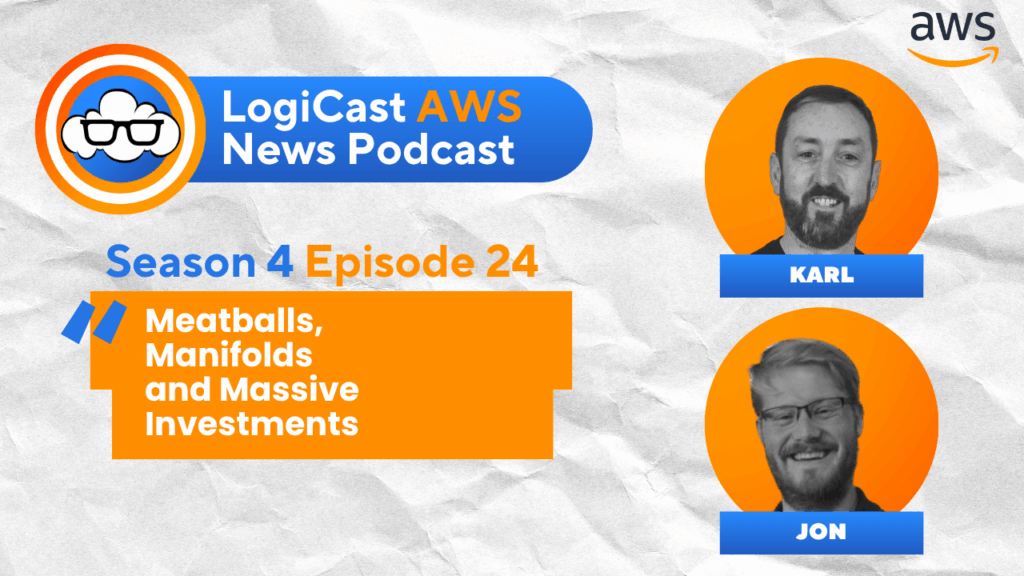
The latest episode of LogiCast, the AWS news podcast by Logicata, featured an exciting discussion with special guest Matheus Guimaraes, Lead Developer Advocate from AWS. Hosts Karl Robinson and Jon Goodall delved into some of the key announcements from AWS re:Invent 2025 and the pre:Invent period, offering valuable insights for AWS users and enthusiasts.
Re:Invent Recap and Pre:Invent Insights
Matheus shared that the official re:Invent recap deck, which he helped create, includes both pre:Invent and re:Invent announcements. He emphasized the importance of pre:Invent releases, noting that they often get overlooked amidst the re:Invent buzz. Matheus explained that the timing of announcements isn’t necessarily a reflection of their importance, but rather a result of various factors including product timelines, dependencies, and the need to manage information flow to customers.
The Revival of AWS CodeCommit
One of the most surprising announcements discussed was the resurrection of AWS CodeCommit. Previously deprecated, CodeCommit has now been brought back into general availability. Matheus explained that this decision was a direct result of customer feedback:
“We listen to our customers like all the time. 90 to 95% of what we release comes from customer feedback. No joke, right? And then the other 5% is what we invent on your behalf.”
He emphasized that the decision to bring back CodeCommit was not taken lightly and was driven by overwhelming customer demand. The service now comes with a public roadmap, including plans for Git LFS support and expanded regional availability.
Jon expressed mixed feelings about the revival, noting that while some users will be happy, others who have already migrated away from CodeCommit may be reluctant to return. Matheus acknowledged this, stating that AWS doesn’t expect all users to migrate back, but rather wants to provide options for those who need the service.
AWS Builder Center Wishlist
The discussion touched on the AWS Builder Center wishlist feature, which allows users to submit and upvote feature requests. Matheus explained that this system provides a direct line of communication between customers and product teams. He encouraged users to submit as many wishes as they want and to promote their ideas to gain visibility.
ECS Express: Simplifying Container Deployment
A notable announcement was ECS Express, a new feature designed to simplify the process of getting started with Amazon Elastic Container Service (ECS). Matheus described it as a way for users to quickly set up ECS clusters with sensible defaults based on best practices:
“It’s removing a lot of the stuff that comes with the containers implementation so that teams can just get started with it without losing any control.”
He emphasized that ECS Express is not just a sandbox environment but can be used for production workloads. Jon expressed interest in the feature, seeing it as a potential time-saver for certain use cases.
ECR Archiving: Cost Optimization for Container Images
The introduction of an archive tier for Amazon Elastic Container Registry (ECR) was discussed as a significant cost optimization feature. Matheus explained that this feature addresses compliance needs for long-term image retention while reducing storage costs. The archive tier includes smart features like automatic archiving based on image pull dates and automatic restoration when an archived image is needed.
Jon saw this as a useful feature for compliance scenarios, noting that it could simplify conversations around maintaining built artifacts for auditing purposes.
Blue-Green Deployments for Aurora Global Database
One of the more technical announcements covered was the introduction of blue-green deployments for Aurora Global Database. Matheus highlighted the complexity of implementing blue-green deployments across a globally distributed database and how this feature simplifies the process:
“Now this is production, now this is your old environment and Aurora Global supports that all the way up to the 10 regions. If you’ve got 10 regions of databases, it will do all that for you and set up those environments and replication as well.”
Jon expressed particular interest in this feature, especially its potential for handling schema changes, which he described as “the holy grail of DevOps within the database.”
Accelerated Recovery in Route 53
In light of recent AWS outages, the introduction of accelerated recovery in Route 53 was discussed. This feature allows customers to continue making DNS updates even if the primary region (US-East-1) is experiencing issues. Matheus explained:
“You can just go on a tab like on the console… go accelerate recovery and turn it on for that account, and that means you’re gonna have 60 minute SLA to continue doing your DNS updates while North Virginia is down.”
Both hosts emphasized the importance of proper architecture design to minimize the impact of regional outages, with Karl noting that none of Logicata’s managed customer environments were affected by the recent high-profile AWS outage.
Conclusion
The discussion highlighted AWS’s commitment to customer feedback and continuous improvement of its services. From reviving deprecated services to introducing new features that simplify complex processes, the announcements covered in this episode demonstrate AWS’s responsiveness to user needs and its focus on providing robust, scalable cloud solutions.
As the AWS ecosystem continues to evolve, staying informed about these updates and new features is crucial for businesses and developers looking to optimize their cloud infrastructure and workflows.
This is an AI generated piece of content, based on the Logicast Podcast Season 4, Episode 46.