
Logicata AI Bot
December 8, 2025
The Logicata AI Bot automatically transcribes our weekly LogiCast AWS News Podcasts and summarises them into informative blog posts using AWS Elemental MediaConvert, Amazon Transcribe and Amazon Bedrock, co-ordinated by AWS Step Functions.
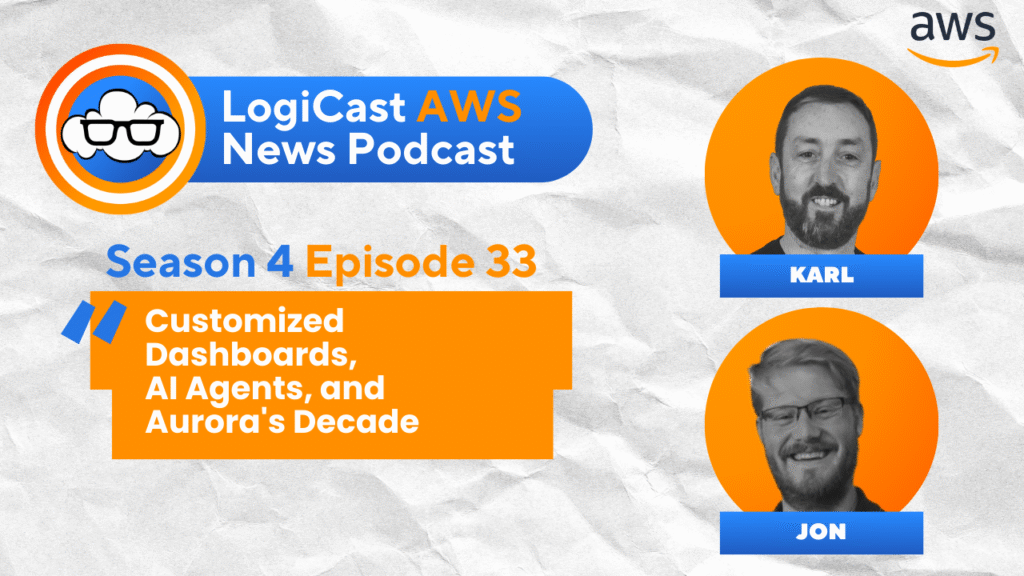
The AWS re:Invent 2025 conference in Las Vegas brought a flurry of exciting announcements and new features. In this episode of LogiCast, host Karl Robinson and co-host Jon Goodall from Logicata are joined by AWS Hero, Johannes Koch to discuss some of the key highlights from the event.
re:Invent 2025 Atmosphere
Johannes, who attended re:Invent in person, shared his experiences and highlights from the conference. He mentioned that while the event was exciting, it was also exhausting, with attendees typically getting very little sleep during the week-long conference. Some of Johannes’ personal highlights included:
1. Adobe’s Transform event, where they dramatically showcased their fight against technical debt.
2. Meeting with important people and having meaningful side conversations.
3. Reuniting with a mentee from India who attended re:Invent for the first time.
4. Werner Vogels’ emotional final keynote as AWS CTO.
Johannes also noted that while swag was still prevalent at the event, he personally didn’t collect much. He did mention a cocktail shaker as one of the more interesting items he received.
Key Announcements and Features
- Lambda Managed Instances
AWS announced Lambda Managed Instances, which aims to provide serverless simplicity with EC2 flexibility. This feature allows users to run Lambda functions on EC2 instances that they manage, potentially eliminating cold starts and providing more control over the underlying infrastructure.
Jon expressed some skepticism about the need for this feature, stating, “I don’t actually get it why you’d want to run serverless on servers.” He noted that while it might solve the cold start problem, it introduces new complexities and changes the billing model.
Johannes provided additional context, explaining that the main change is giving users the ability to decide on the instance types and technology used under the hood. He also pointed out that this feature might be particularly useful for organizations with large Lambda consumption looking to better utilize compute savings plans.
2. Database Savings Plans
One of the most well-received announcements was the introduction of Database Savings Plans. This new offering allows customers to save up to 35% on their database costs by committing to a consistent amount of usage over a one-year term.
Jon expressed mixed feelings about the announcement, stating, “I’ve been asking for this sort of thing for a very, very long time.” However, he also noted some limitations, such as the lack of a three-year option and the fact that not all database services and instance types are included.
Johannes added that while the savings potential is significant, he questioned whether it would significantly impact decision-making around database usage. He also pointed out that the feature primarily covers AWS-specific databases, excluding third-party options like SQL Server.
3. New EKS Capabilities
AWS announced new Amazon EKS capabilities for workload orchestration and cloud resource management. These features aim to simplify the management of Kubernetes clusters and associated resources.
Jon admittedly not a big Kubernetes fan, acknowledged the potential benefits of these new capabilities. He particularly appreciated the inclusion of managed Argo CD, stating, “I’m all for things doing more for you, so you don’t have to.”
Johannes provided a more in-depth perspective, explaining that these announcements represent another step in AWS expanding the capabilities of the Kubernetes control plane. He sees this as AWS taking on more responsibility in the shared responsibility model for Kubernetes deployments.
AI Frontier Agents
A significant portion of the re:Invent keynote was dedicated to AI announcements, including the introduction of three new “Frontier Agents“:
1. Autonomous Agent for Amazon CodeWhisperer
2. Security Agent
3. DevOps Agent
These agents are designed to automate and enhance various aspects of software development, security, and operations tasks.
Johannes, who had the opportunity to test some of these agents, shared his experiences. He found the CodeWhisperer agent particularly useful, noting that it helped him implement multiple features for a project while he was at re:Invent.
Regarding the DevOps agent, Johannes expressed some reservations about the name, arguing that “DevOps” is not a job title but a culture. However, he acknowledged the potential of the agent in automating incident response and remediation tasks.
Jon showed interest in the DevOps agent’s capabilities, particularly its potential to automate responses to alerts and reduce the need for manual intervention during off-hours incidents.
Conclusion
re:Invent 2025 showcased AWS’s continued focus on innovation across its service portfolio. While AI took center stage, significant improvements in areas like serverless computing, database cost optimization, and Kubernetes management demonstrate AWS’s commitment to addressing customer needs across the board.
As the cloud computing landscape continues to evolve, it’s clear that AWS is positioning itself at the forefront of both AI-driven innovations and practical improvements to its core services. The introduction of Frontier Agents and the expansion of managed services point to a future where cloud resources become increasingly autonomous and self-managing.
For AWS users and enthusiasts, the coming months will be an exciting time to explore and implement these new features, potentially transforming the way we build, deploy, and manage cloud applications.
This is an AI generated piece of content, based on the LogiCast Podcast Season 4 Episode 45.