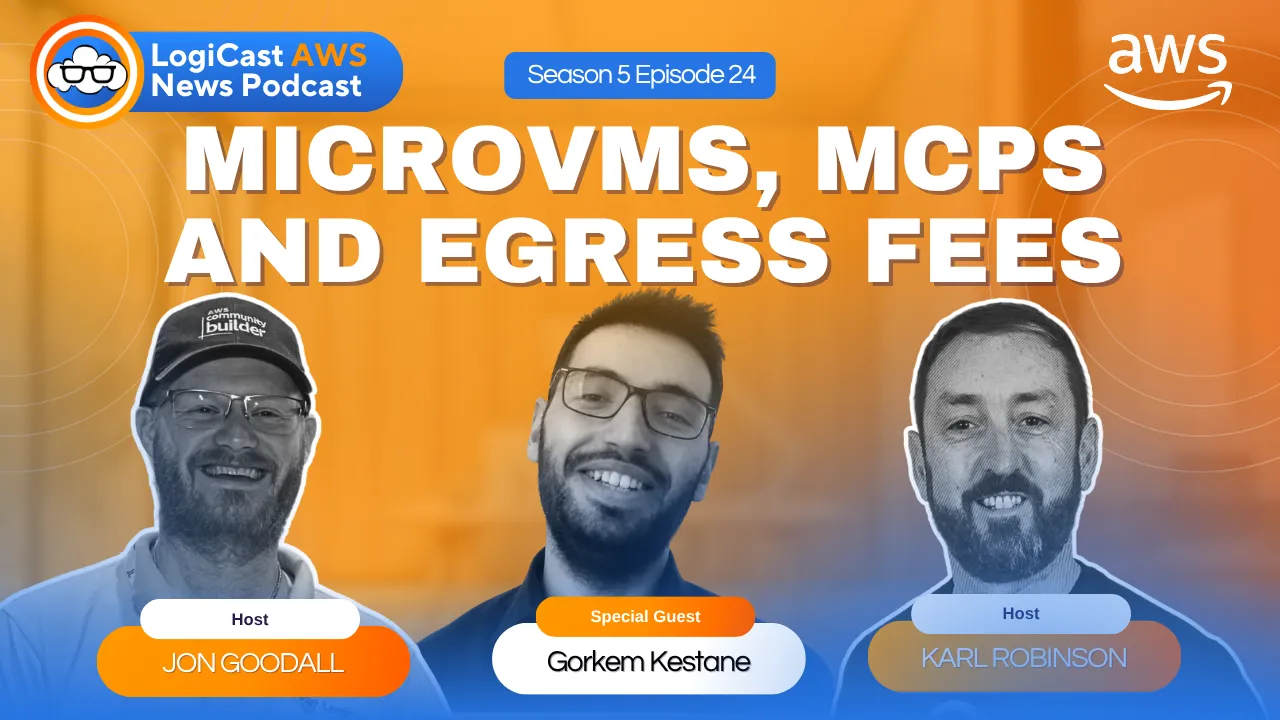
LogiCast AWS News: The Future of AI-Driven Workflows and Cloud Gatekeeping
Welcome to season 5, episode 24 of LogiCast, the AWS News podcast brought to you by Logicata. I’m Karl Robinson, CEO and co-founder of Logicata, and I’m joined today by Jon Goodall, Principal Cloud Engineer at Logicata. We’re delighted to have Gorkem Kestane with us today, all the way from Istanbul, Turkey. Gurkem is a former Amazon community builder and an expert in machine learning and cloud technologies.
Micro VMs: Small Servers for Serverless
We kick off our discussion with a new AWS service, Lambda Micro VMs. Jon highlights the unique selling point of Micro VMs, which offer a balance between the speed of containers and the persistent disk of traditional servers.
Gorkem notes that Micro VMs essentially provide a container with persistent storage, addressing the limitations of traditional containers. Karl draws parallels to AWS CloudShell, explaining that Micro VMs give users access to the underlying technology of CloudShell but with more flexibility and control.
The conversation shifts to potential use cases for Micro VMs, such as coding assistance, interactive environments, and data analytics platforms. Jon expresses some confusion about the necessity of Micro VMs but acknowledges their potential for securely running untrusted code.
MCP and AI-Driven Workflows
Next, we delve into Model Context Protocol (MCP), a standard for enabling agents to communicate with various tools and APIs. Jon explains that MCPs have become a standard for agent-to-tool communication, reducing the need for custom integrations.
Gorkem emphasizes the importance of understanding and working with pre-built MCPs, noting that creating custom MCPs is not yet a widespread practice. The discussion touches on security considerations, including the need for strong authentication and authorization mechanisms when AI systems interact with critical systems like Kubernetes clusters.
AWS Certifications: Moving Beyond Exams
Our third article discusses a new method for renewing AWS certifications without taking an exam. Jon explains that this method is for renewals only and involves completing AWS Skill Builder training and lab activities. Karl appreciates this approach, especially for those who struggle to find time for exams.
Gorkem highlights the importance of practical, hands-on learning in maintaining certifications. The discussion includes perspectives on the value of exams versus continuous learning, with differing opinions on the new certification renewal method.
Amazon Quick: More Than Just a Chatbot
We then explore Amazon Quick, an AI assistant born out of QuickSight. Jon Goodall shares his frustrating experience setting up Amazon Quick, noting the complexity of the process and the high costs involved. Despite these challenges, he acknowledges the tool’s potential for enhancing productivity once properly configured.
Gorkem sees Amazon Quick as part of a broader vision to create a central workplace platform that connects enterprise data sources and automates workflows. The conversation highlights the need for a mindset shift among users to fully leverage the tool’s capabilities.
EU’s Gatekeeper Regulation and Egress Fees
Our final article discusses the EU’s plan to designate AWS and Azure as “cloud gatekeepers” under the Digital Markets Act (DMA). Jon explains the criteria for being designated a gatekeeper and the potential implications for cloud providers.
Gorkem discusses the egress fees charged by cloud providers and the EU’s aim to reduce vendor lock-in. The conversation concludes with skepticism about the effectiveness of the EU’s proposed regulations, with Jon and Karl questioning whether the regulations will lead to meaningful changes or simply reduce cloud providers’ profits.
This is an AI-generated piece of content, based on the LogiCast Podcast season 5, episode 24.