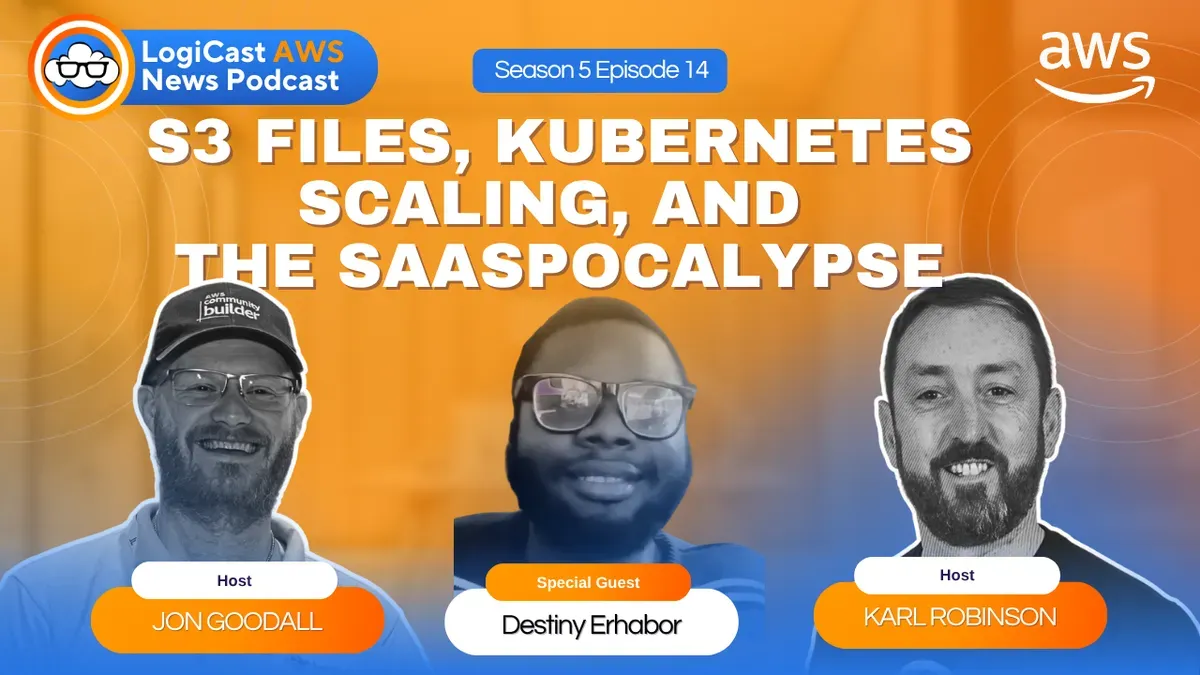
LogiCast AWS News: S3 Files, Kubernetes Autoscaling, and the AI Investment Strategy Shaping AWS's Future
Welcome to our deep dive into Season 5, Episode 14 of the LogiCast AWS News Podcast, where Karl Robinson, Jon Goodall, and guest Destiny Erhabor explored some of the most significant developments in the AWS ecosystem. From groundbreaking storage innovations to infrastructure resilience lessons, this episode covered the news that’s shaping how teams work with cloud technology today.
S3 Files: The File System Revolution Nobody Knew They Needed
The most significant announcement this week was undoubtedly the launch of S3 Files, which fundamentally changes how organizations interact with S3 buckets. As Karl explained, this feature makes S3 buckets accessible as file systems—but not in the way you might initially think.
Jon was particularly animated about this release, noting that “this solves for a lot of problems.” The key innovation here is that AWS didn’t turn S3 into a file system; instead, they put a high-performance file system in front of S3. This distinction is crucial. As Corey Quinn aptly described it in his own analysis (which Jon referenced), previous workarounds were like “saddling a fish and calling it a horse.” S3 Files is something entirely different.
The technology works through an intelligent caching mechanism that uses SSD storage as a lazy-loaded (and write-through) cache. When you need a file, it retrieves it from S3. When you access files more frequently, the system intelligently prefetches them. “It’s fantastic, it’s brilliant,” Jon remarked. This solves a long-standing problem for organizations that need POSIX-compliant file system access to petabyte-scale data already stored in S3.
The Pricing Question
Destiny raised an important consideration about the pricing structure. While S3 Files does add complexity to your bill—you pay for S3 storage, the file system itself, data throughput, and storage within the file system—Jon noted that the pricing generally works out to be roughly equivalent to standard EFS pricing. The real win comes when you have massive data stores but only interact with a small percentage of them. In those scenarios, you can pair S3 Files with S3 Intelligent-Tiering or archive storage classes to realize significant savings.
Watch Out for These Gotchas
Destiny also highlighted an important caveat: the synchronization between the file system and S3 isn’t instantaneous. While AWS claims files should be accessible within a millisecond, there’s a potential lag of up to a minute in some cases. Additionally, Jon noted that certain workloads—particularly those that regularly rename directories—can become punitively expensive with S3 Files because renaming a directory involves deleting and recreating every file within it.
Migration from legacy solutions like S3FS isn’t particularly complicated. Since your data is already in S3, you can enable the file system and switch your mount points with minimal downtime. However, Jon cautioned that the cost profile may change compared to S3FS, which operates using API calls without incurring file system-specific fees.
EKS Warm Pools: Kubernetes Gets More Intelligent
The second major announcement involved managed node groups for Amazon EKS now supporting EC2 Auto Scaling warm pools. Jon selected this article specifically because it represents another victory for what he calls “the lazy engineer”—which, in the best possible way, means building systems that require less manual intervention and configuration.
Jon had personal experience with this type of setup. Years ago, he manually built an EKS cluster that required him to manage EC2 instances, use spot instances for cost savings, and implement warm pools—all manually. “It was a complete pain to build,” he admitted. The process involved managing cluster autoscaling, horizontal pod autoscaling, spot instance termination notifications, and carefully orchestrating everything so that workload scaling and infrastructure scaling worked in harmony.
Making Infrastructure Management Boring
What’s remarkable about this new feature is that AWS has taken the complex pieces that engineers like Jon had to build themselves and integrated them into managed node groups. “Now managed node groups, which is EKS give me servers please, does that for you as well, and it works with cluster auto scaling without any additional configuration,” Jon explained. Managed node groups already supported spot instances, and now with warm pool support, you get most of the sophisticated scaling behavior without additional effort.
Destiny appreciated this from a practical standpoint. Before this feature, teams either had to build custom solutions or over-provision their EKS clusters—both expensive propositions. Now, handling traffic spikes is simplified. “I mean, if it makes it easier, why not?” Destiny said.
The True Cost of Engineering
Jon raised a point that often gets overlooked in cost-benefit analyses: the salary cost of the engineer implementing the solution. He managed to save about $600 per month with his manual setup, but the engineering time required to build it—possibly a month of work—meant the solution took far longer to pay for itself than AWS’s potentially slightly more expensive automated option. From a total cost of ownership perspective, managed solutions often win decisively.
Drone Strikes on Data Centers: A Disaster Recovery Wake-Up Call
The third article discussed the ongoing situation in the Middle East, where AWS data center regions have been experiencing disruptions due to military attacks. AWS CEO Andy Jassy announced that teams were working around the clock to maintain service availability, and the company refunded an entire month’s subscription for customers in affected regions.
The Scale of the Impact
Destiny raised the sobering reality that this represents the first time a data center has been the target of military action. The attack affected 22 services simultaneously, with the impact extending well beyond the directly targeted region. Looking at AWS’s service health dashboard, Karl found that only three services remained fully operational—Global Accelerator, CloudFront, and Traffic Mirroring, and only because they operate on AWS’s backbone rather than in the regional infrastructure.
The full impact is staggering: 51 services are impacted, 34 are degraded, and 25 are completely disrupted. Most alarmingly, AWS Backup is listed as disrupted, meaning customers who relied on automatic backups for disaster recovery were potentially at risk.
Lessons for Disaster Recovery
Destiny pointed out that startups and growing companies face a particularly difficult situation. While large enterprises can afford to architect across multiple regions and availability zones, this adds significant cost. “We are at the mercy of the people in power,” Destiny observed. “In case there’s a crisis here, we need to make sure it doesn’t affect the other region, hopefully, right? Or we pray this type of war and crisis doesn’t happen.”
AWS’s standard SLA promises 99.99% uptime, not 100%. Acts of war typically fall outside standard SLA coverage, though AWS did choose to credit affected customers. Jon made a critical point: if your data isn’t replicated elsewhere, military action—or floods, fires, or power failures—could result in permanent data loss.
Karl highlighted that AWS is actively recommending customers move away from affected regions as quickly as possible. AWS Support is available for those who cannot immediately migrate, but the message is clear: you cannot rely on a single region for mission-critical workloads.
AI Investment Strategy: Playing Both Sides
The final three articles came from interviews with AWS CEO Matt Garman at the Human X conference in San Francisco. The first addressed what might seem like a conflict: AWS’s substantial investments in both OpenAI and Anthropic simultaneously.
Why This Isn’t Actually a Conflict
Jon sees this as defensible from AWS’s perspective. “They’ve invested in one thing, they’ve invested in another, they’ve taken ownership in one of them,” he explained. His frustration with AWS’s approach is not with the dual investment but with how it’s structured—using service credits rather than direct capital. “The way it’s all been done should be completely illegal because they’re just sort of passing credit notes around between each other,” he said bluntly.
But from a strategic platform perspective, Jon’s position becomes more nuanced. “So long as the money keeps flowing, who really cares? AWS is providing their own models as well, and that’s a conflict that people aren’t really talking about.” This is arguably the bigger conflict—AWS is simultaneously:
– Investing in external AI companies through OpenAI and Anthropic partnerships
– Building their own competitive AI models through the Amazon Nova family
– Using these on AWS services directly
Destiny agreed that from a business perspective, spreading investment across multiple AI players makes sense, especially given the rapid pace of innovation in the field. “The money needs to keep coming and we’re in the AI era, right? So it’s, who gets who first, right?” He advocated for hedging bets: “Let’s spread the money. Let’s spread it out. Let’s have a broad break on the matter.”
Amazon’s Models: The Dark Horse
What’s interesting is that Amazon’s own models—the Nova family—are becoming genuinely competitive. Karl has been using Nova Light models for podcast post-processing after transitioning away from Claude 3.5 Sonnet. His assessment: the Nova models are “significantly cheaper” and he thinks they’re “better,” though they’re much newer so the dataset is smaller.
From a price-to-performance perspective, Karl estimated that Nova Light is approximately 50% better than the previous model for roughly one-third the cost. For use cases where you need good performance at minimal cost, Amazon’s models are increasingly attractive. This matters for AWS’s business because it creates a path for customers to reduce their spending on third-party AI models while maintaining or improving performance.
The SASPocalypse: Real Threat or Overblown Concern?
The final article addressed the so-called “SASPocalypse“—the theory that AI will make SaaS tools obsolete because developers can quickly build their own solutions using AI.
Why This Concern Is Overblown
Jon was particularly dismissive of this apocalyptic framing. “I don’t think that’s going to happen, right, in the same way that I don’t think AI is gonna get rid of everybody’s jobs because that’s just fear mongering,” he said. He drew a historical parallel: the loom didn’t eliminate weaving jobs; it transformed them.
The critical insight is that SaaS tools were never adopted primarily because building in-house solutions took too long. They were adopted because SaaS companies are better at running those services than individual businesses are. A team at Logicarta could theoretically build their own Git server, but they use GitHub because Atlassian runs Jira better than they could, and Monday.com runs their scheduling system better than an in-house build would.
“Building your own tool is still, even though you can do it quickly, very rarely the correct move for a lot of things, right? As a business, Logicata is, I think we’ve called it SAS first, like we will just, as a rule, I don’t run, want to run workloads that I don’t have to,” Jon emphasized.
Destiny concurred, adding an important distinction between internal and customer-facing tools. “Maybe minor stuff that I’m doing, right? I can just run something and it’s not a customer facing SAS product is just for an internal workload, right?” There’s a meaningful difference between building internal tools with AI assistance and replacing established SaaS platforms.
The Evolution of Work, Not Its Elimination
Matt Garman reported that roughly 70% of the audience at Human X had experienced positive ROI from their AI investments. Amazon’s own software developers are approximately 4.5 times more efficient when using AI tools. These statistics point to AI as an evolutionary force, not a revolutionary one.
Karl noted that he accidentally created an application while trying to write a script with overly detailed prompting. This illustrates the modern reality: with AI tools, even those without formal development training can create functional applications. However, this doesn’t mean SaaS tools will disappear—it means developers can be more productive building business logic rather than infrastructure, which paradoxically might increase demand for well-built SaaS platforms that handle the undifferentiated heavy lifting.
Looking Forward
These four articles represent the current state of cloud computing: we’re in a period of rapid technological advancement, from storage innovations to AI integration, while also grappling with real-world challenges like infrastructure resilience and business model disruption.
The key takeaway is that progress in cloud computing isn’t eliminating existing categories—it’s creating new possibilities within them. S3 Files doesn’t replace other storage options; it creates a new option for specific use cases. EKS warm pools don’t make Kubernetes simpler; they make it accessible to teams without the resources to build sophisticated automation. Amazon Nova models don’t eliminate the need for third-party AI services; they provide cost-effective alternatives for certain workloads.
As we move forward, the teams that will thrive are those that take these tools not as panic-inducing replacements but as opportunities to rethink their architectures, improve their reliability, and ultimately deliver more value to their customers.
This is an AI generated piece of content, based on the Logicast Podcast Season 5, Episode 14