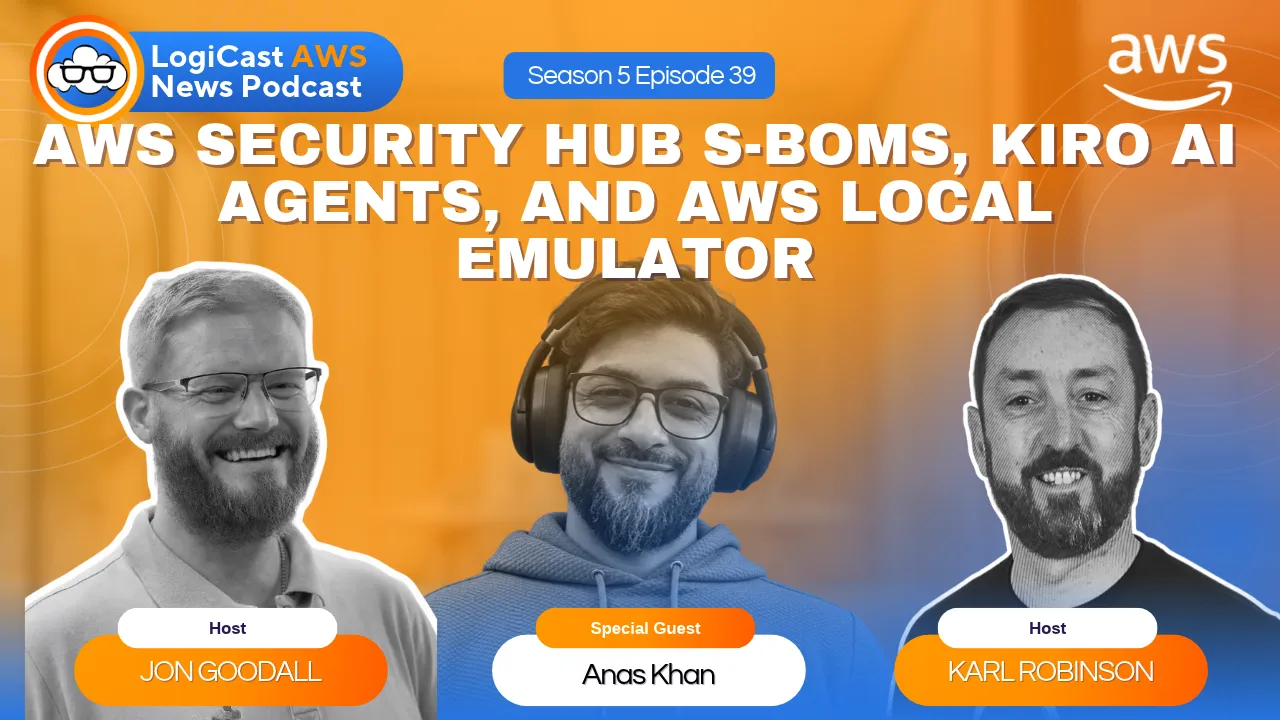
LogiCast AWS News: SBOMB in Security Hub, Kiro Agents, QuickSight Rebranding, GuardDuty Alert Tuning, and the AWS Local Emulator
Season 5, Episode 39 of the LogiCast AWS News Podcast brought together hosts Karl Robinson, CEO and co-founder of Logicata, and Jon Goodall, principal cloud engineer at Logicata, alongside guest Anas Khan, a technology advisor and UK team lead at Assured Data Protection who also hosts the Tekawati podcast. The episode covered five AWS topics: SBOMB support in AWS Security Hub, Kiro’s autonomous agent capabilities, the Amazon QuickSight to AWS QuickSight rename, alert fatigue reduction in Amazon GuardDuty, and the launch of the new AWS Local Emulator.
SBOMB Inventory in AWS Security Hub
AWS Security Hub now provides a software bill of materials - an SBOMB - inventory for compute resources, giving teams visibility into what software versions are running across their estates. Jon connected this directly to work Logicata has been doing internally around configuration management databases and improving its managed service offering. The PHP vulnerability - referred to as the “PHP apocalypse” - was the practical example he reached for: “you’ve got this, I mean, there was a vulnerability in the SSM agent itself a little while ago… this is the sort of thing that starts to say that, oh yes, I’m affected by all of these because I’ve got these versions of stuff across the estate.”
Jon noted that this capability sits in Security Hub version 2, not the original Security Hub - now rebranded as Security Hub CSPM - and that while the new version does carry a cost, it adds no extra charge on top of what customers are already paying. He was enthusiastic about SSM Agent as the underlying mechanism, pointing out it comes pre-installed on Amazon Linux and Ubuntu and is Logicata’s default access mechanism for customer environments.
Anas acknowledged the cynical reading - that AWS is replicating something third-party tools already do - but accepted the logic of it. “If I can keep it in-house, of course I’m going to,” he said. His more pointed observation was about process: having the tool is one thing, but knowing who responds to a vulnerability finding, and how, is a separate problem entirely. “If you’ve got a fire blazing, you don’t want an ambulance to turn up to try and put the fire out.”
Kiro Agents and Autonomous AI Development
An article from The New Stack covered AWS Kiro’s approach to autonomous AI agents - specifically Kiro’s ability to maintain its own memory and run parallel agent sessions, with the aim of reducing the need for constant human approval during development tasks. Jon described his own experience as a heavy Kiro user, noting that he still tends to sit in the IDE and work through plans and specifications rather than fully delegating. The appeal of a fleet of purpose-built bots - each responsible for a specific task like issue tracking, release notes, or weekly reports - was clear to him, but so was the reservation. “I still like looking at stuff in the IDE.”
One design decision he highlighted was that bots cannot delegate to other bots, which Kiro calls a safeguard against “context rot” - the degradation that happens when instructions pass through multiple layers. He used the analogy of a photocopier run through itself repeatedly, or a game of telephone, to explain why the quality of output deteriorates through chains of delegation.
Anas raised concerns about context quality and organisational readiness. He described the problem of feeding AI tools input that is “even 99% good” - the remaining 1% can produce garbage output, and if junior or inexperienced staff are the ones checking the results, they may not know what good looks like. “If you don’t know what good looks like, whatever it spits out, you’re going to take it probably for granted.” Both he and Karl agreed that understanding the process you are trying to automate is a prerequisite - the same discipline required when delegating to a human employee.
Amazon QuickSight Becomes AWS QuickSight
The rebrand of Amazon QuickSight to AWS QuickSight generated more discussion about naming conventions than about the product itself. Karl noted the change had appeared on his desktop QuickSight client and speculated about the reasoning. Jon observed that while AWS services regularly carry either the Amazon or AWS prefix, he could not recall a service previously crossing from one camp to the other mid-lifecycle. “I don’t remember them going from the Amazon camp to the AWS camp, so it’s a bit of a weird one.”
His working theory was that the AWS brand carries stronger equity among engineering audiences, and that moving QuickSight under that banner signals who the intended users are - engineers rather than sales and marketing teams. Anas offered a more colourful explanation, suggesting there is a kind of internal fight club between Amazon and AWS marketing teams that determines naming rights. The practical consensus was that the rename changes nothing for existing users.
Reducing Alert Fatigue in Amazon GuardDuty
An AWS Security Blog post outlined how teams can customise threat detection in Amazon GuardDuty to reduce alert fatigue - through custom detection rules, dry runs before enabling rules, threat entity lists, and automatic triage of findings. Jon described alert fatigue management as a Sisyphean task - “you will never ever, ever fix this problem” - but argued that incremental improvement is still worth pursuing.
He walked through a practical sequence for new GuardDuty deployments: turn it on, let it settle for a few weeks before connecting alerting via EventBridge, then begin tuning. The automatic triage feature - which uses an agent to correlate signals and assess whether a finding warrants investigation - was still in preview at time of recording. Jon also flagged the value of custom detection rules for surfacing attack patterns specific to a given environment, alongside dry runs to check noise levels before enabling a rule.
Anas reached for a rave analogy: a poorly tuned alert system is like standing in front of a speaker wall of noise, while one that is over-suppressed is like being outside a silent disco hearing nothing but squeaking trainers. “What you actually need is a nice harmonious kind of sound coming towards you that somebody has spent the time to curate.” He echoed the earlier theme around process - having the right people identified to respond to findings matters as much as the tooling itself.
AWS Local Emulator
AWS released a local emulator allowing developers to test applications against AWS services on their own machines, without calling out to AWS. Jon was measured in his enthusiasm, noting that his instinct has always been to test in a dev account rather than locally, particularly for event-driven architectures where end-to-end behaviour only makes sense in the actual environment. He acknowledged LocalStack as the established tool in this space but said he had filed it away years ago after finding it too basic at the time.
His more positive observation was about the CI pipeline use case - the emulator appears designed to run in a CI process, creating a kind of ephemeral environment that never touches AWS at all, without requiring the endpoint mocking that LocalStack involves. “Who better to emulate AWS than AWS?” he noted. The emulator is built in Rust - which Jon felt compelled to point out comes with its own social obligations. “I’ve never once come across people that use rust and just don’t tell you.”
Anas framed it as horses for courses: useful when what you are testing is self-contained, less useful when there are wider dependencies. He compared it to learning to drive in a car park - fine for the basics, but a different situation once traffic lights and other drivers are involved. The emulator is generally available and free.
---
The full episode is available on all major podcast platforms and on the Logicata YouTube channel.
*This is an AI generated piece of content, based on the LogiCast Podcast Season 5, Episode 39.*