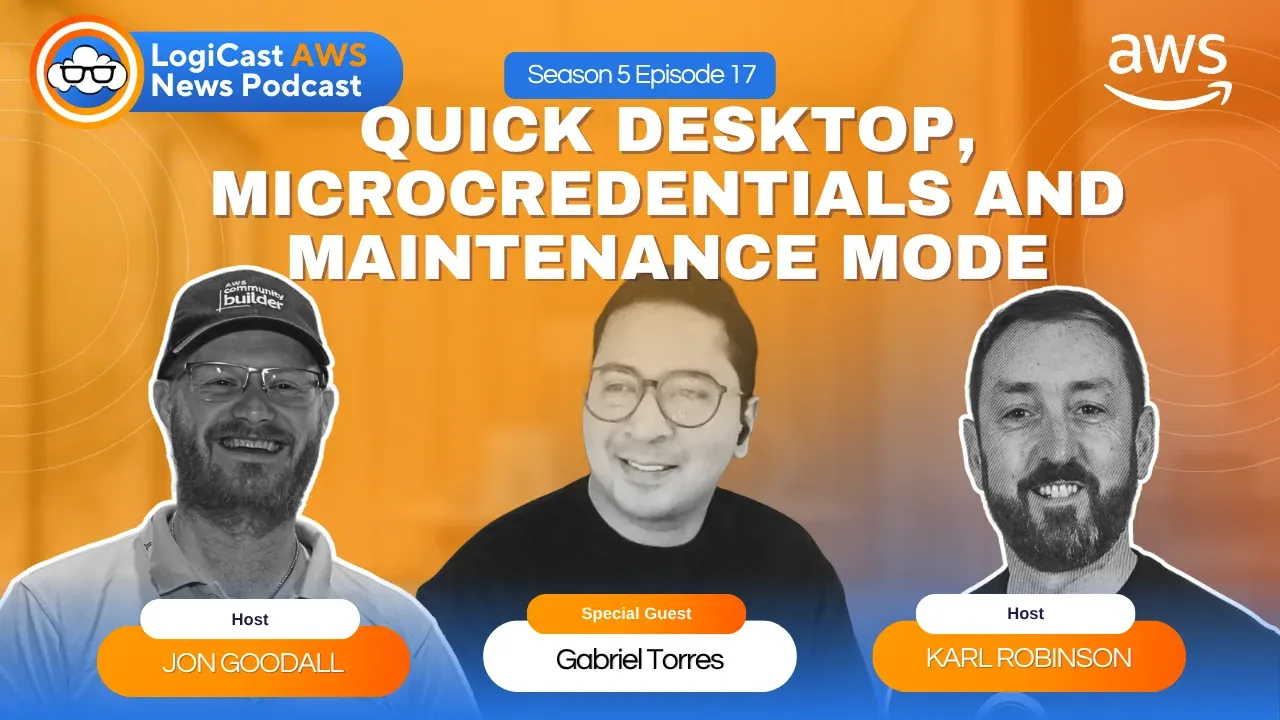
LogiCast AWS News: Quick Desktop, Microcredentials and Maintenance Mode
Welcome back to another action-packed episode of LogiCast, the AWS news podcast brought to you by Logicata. In this week’s episode, host Karl Robinson and principal cloud engineer Jon Goodall are joined by Gabriel Torres to discuss the latest developments in the AWS ecosystem. From Amazon’s latest foray into desktop applications to significant certification updates and strategic shifts in OpenAI’s partnerships, there’s plenty to unpack.
Amazon Quick Desktop: AWS Takes Another Shot at the App Market
One of the most significant announcements this week is the launch of Amazon Quick Desktop AI Assistant. As Robinson notes, AWS has had numerous failed attempts to break into the application space, and the question remains: is this finally the product that will change their fortunes?
Robinson downloaded and tested the application last week and came away impressed. “It looks pretty good,” he reported. “It’s got a much nicer user interface compared to some of the other tools out there.”
Goodall initially expressed confusion about the naming convention. “To start with, it sort of confused me on the naming because there’s a whole bunch of other quick things that aren’t this and aren’t necessarily AI, right? There’s QuickSight, which my thoughts are public record on. I don’t enjoy using it,” he explained. However, after further investigation, Goodall warmed to the concept.
What makes Quick particularly compelling, according to Goodall, is its integration with existing AWS services and its approach to data security. “It’s running Bedrock. It’s not sending data back to Anthropic or Mistral or OpenAI or whoever, right? It’s staying where it is, which covers for a lot of security concerns for a lot of people because your data isn’t leaving Amazon,” Goodall observed. This is a critical feature for enterprises concerned about data governance and compliance, a concern that Torres emphasised as particularly important for his work in the banking sector.
The pricing model is accessible: $20 per user per month when billed annually, or $25 monthly. There’s also a free trial available. Torres noted the appeal of Quick from a governance perspective: “We have started using testing this Amazon Quick, and from my perspective, like cyber liability in general, it’s pretty nice because we can automate different kinds of things on a daily basis.”
However, Robinson remains cautiously optimistic about AWS’s chances of success. “I do question how successful Amazon are gonna be with it, even though I think it looks pretty cool, there’s other cool things out there. Is it a little bit late to the market, have other people stolen the march, or is it gonna have some killer feature that others don’t have?” This uncertainty reflects the reality that AWS faces significant competition from established players like Microsoft’s Copilot and other AI assistants.
Serverless Microcredentials: Filling a Gap in AWS Certifications
One development that Goodall was particularly excited about is the introduction of AWS Microcredentials, a new approach to professional certification. These bite-sized credentials represent a significant shift in how AWS approaches training and professional development.
Goodall had been searching for a way to validate serverless expertise for some time. “Prior to the serverless microcredential, you could do some serverless ready stuff, right, which is just you’ve done this kind of mini test, which fine, OK, whatever. But there’s no specialty exam, there’s no foundation, there’s none of this, and I always thought that was a bit iffy,” he explained.
The microcredentials now available include serverless, agentic AI, networking, and incident response. These aren’t your traditional exam centre experiences. Instead, they’re hands-on labs available through AWS SkillBuilder with no subscription required, a significant departure from expensive certification exams.
“They are hands-on labs, which is something AWS kind of did a little bit with the SysOps version 2 because version 1 was just multiple choice, version 2 had labs, and then version 3 went back to multiple choice. So this is them kind of doing that again as well, which is quite interesting,” Goodall noted.
Torres appreciated the practical focus of these credentials. “I noticed that it’s more based on real problems or real projects and that defines AWS. I’m wondering if one enterprise or one startup wants to see people that have specialized in specific things, that could be one advantage with these microcredentials.”
However, these credentials aren’t without their challenges. Goodall noted, “If you fail, you have to wait 3 weeks before you’re allowed to retry, so they are taking this quite seriously.” Additionally, there’s a 30-minute preview experience available so prospective test-takers can assess their readiness before committing to the full credential attempt.
The Quiet End of AWS Services: WorkMail, App Runner, and More
In what has become an almost routine AWS ritual, several services are being sunset or moved to maintenance mode. This includes WorkMail, App Runner, and various other services that failed to gain significant traction.
Goodall expressed frustration about some of these decisions, particularly regarding App Runner. “App Runner I’m a little bit annoyed about, not because I use it, right, because I do ECS the old fashioned way and I kind of roll it all myself, but it’s absolutely the sort of thing that you, as a less technical development type, would look at and go, ‘cool, that’ll just run my containers for me,’” he explained.
The issue here is that App Runner represented a simplified abstraction over ECS, making containerised workloads more accessible to developers who don’t want to manage the complexity themselves. Its removal forces users to either migrate to more complex solutions or find alternatives.
WorkMail, on the other hand, appears to have been a service few people were using. “Don’t care. Like it’s an email program. I’ve never even used it. I don’t really know what it does,” Goodall said bluntly. The email and collaboration space is dominated by Microsoft 365 and Google Workspace, leaving little room for AWS’s offering.
Torres, however, noted concerns about other services being moved to maintenance mode. “For example, Comprehend and Rekognition for my side project, you know, and I think that resolved a lot of things. That caught my attention that Comprehend and Rekognition will move to maintenance mode,” he said. However, he acknowledged that alternatives exist: “You have other kinds of solutions like ECS last month in the service that can resolve the same things.”
What’s replacing some of these capabilities is Bedrock, AWS’s managed service for accessing foundation models. As Torres noted, many of these retiring features’ functionality can be replicated through Bedrock’s capabilities.
Amazon Q Developer End of Life: The Path Forward
Another significant announcement is the end of support for Amazon Q Developer. Robinson noted that Cody (referring to the competitor tool) made the keynote at the recent London AWS Summit, with most attention focused on Codewhisperer, or Quiro, as it’s now known.
Goodall provided context for why this shift makes sense. “When Q came along, it didn’t really know what it was. I think Amazon has got a much clearer idea of what their AI strategy actually is now, and they’re reversing the fragmentation that they kind of had to start with this big explosion of ‘we’ve got all these new cool things,’” he explained.
However, not all Q functionality is disappearing. “So far as I can work out, Q, the general Q in the console and in various other things in chat apps and Teams, is staying. So it’s only the coding side of things that’s going away,” Goodall clarified.
Torres shared his perspective on why this change is strategically sound. “Amazon Q is one of the services that I don’t recommend to use, basically because the Amazon Q developer in the console has a lot of hallucinations. The answers are not true. However, I noticed that AWS has a new strategy with this new service. Quiro, I think that they are putting everything with this service with spec-driven development. I think that is very nice.”
The move represents a consolidation strategy where AWS is concentrating its developer AI efforts around Quiro, which offers a more specialised approach to agentic coding, using specification-driven development where the AI understands the entire project context, not just individual files.
Microsoft’s OpenAI Exclusivity Ends: Winners Emerge
Finally, Reuters reported that Microsoft and OpenAI have changed their deal terms, effectively ending Microsoft’s exclusive access to OpenAI’s services. This opens the door for Amazon and other cloud providers to offer deeper integrations with OpenAI’s models.
Goodall reflected on what this means for AWS. “So far as we could work out, if you were using the state for runtime environment, all of your calls back to the model were leaving Amazon’s ecosystem, leaving AWS’s servers and calling back out to Azure. That just felt like a lot of legal hoops rather than technical necessity,” he noted about the previous arrangement.
With the exclusivity ended, Torres saw clear winners: “I think that the winners of this change of the terms is Amazon and GCP. Amazon because basically, if you can spin up a server, a lambda, you can spin up elastic container service, make connections directly with the OpenAI API. If you make everything more easy for the customers to connect natively with the OpenAI models, that’s a great benefit.”
However, Torres also pointed out the practical limitations many enterprises face. “At least in my organization or in the enterprise, we have a specific catalog of models that we authorize them to use. Maybe OpenAI we made different connections because we don’t have a deal directly with them. Data privacy and kind of things can be a little more complicated right now to use that kind of model.”
This highlights an important reality: while the technical capability to use OpenAI models is now available across cloud providers, enterprise governance requirements often make such integrations complex and slow to implement.
Conclusion
This week’s episode of LogiCast covered significant developments in AWS and the broader cloud ecosystem. From Amazon’s latest attempt to build consumer-facing applications with Quick Desktop to the consolidation of its developer AI strategy around Quiro, to strategic shifts in partnerships with OpenAI, the landscape continues to evolve rapidly.
Perhaps most interesting is the pattern that emerges: AWS is becoming more focused and strategic in its offerings, consolidating where fragmentation has caused confusion, while simultaneously seeking to make its platform more open and integrated with best-of-breed solutions like OpenAI’s models. Whether these strategies will lead to better outcomes for AWS customers and more sustainable competitive advantages remains to be seen, but one thing is certain, the pace of change shows no sign of slowing.
This is an AI generated piece of content, based on the Logicast Podcast Season 5 Episode 17.