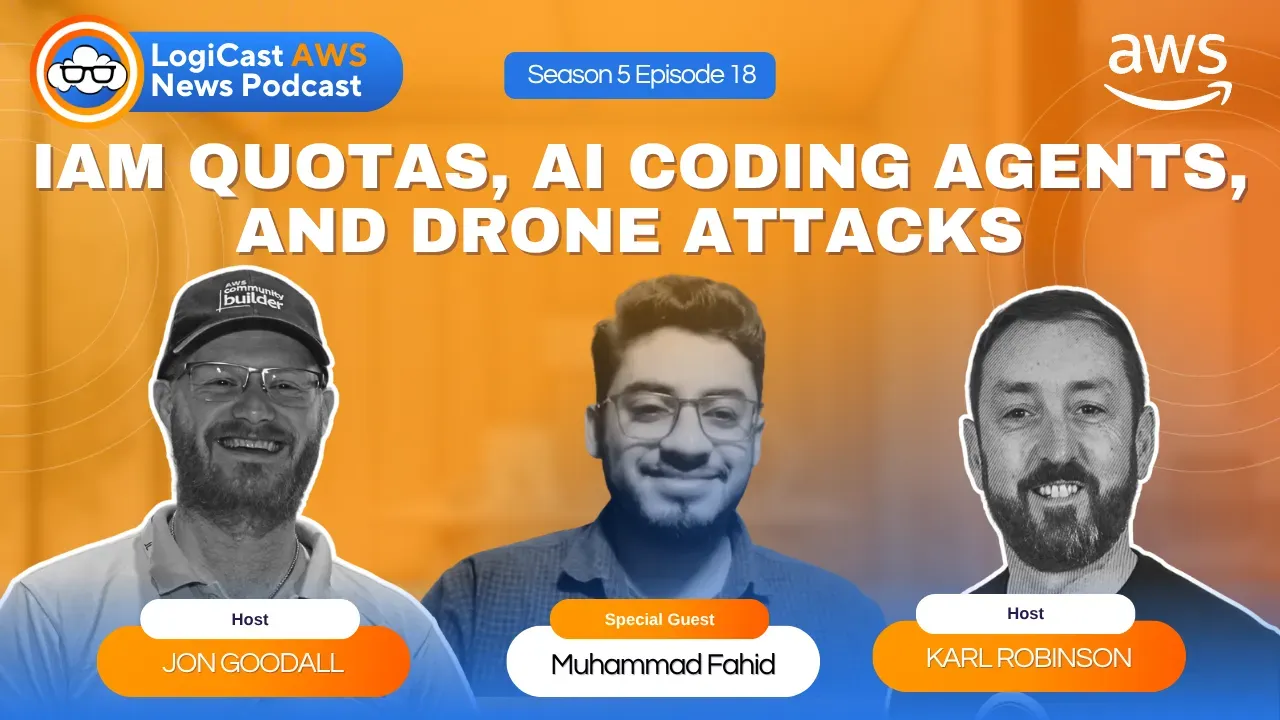
LogiCast AWS News: Navigating Identity, AI Toolkits, and the Future of Cloud Infrastructure
Welcome to our deep dive into Season 5, Episode 18 of the LogiCast AWS News Podcast, where Karl Robinson, Jon Goodall, and guest Muhammad Fahid discussed some of the week’s most significant AWS developments. From incremental but crucial infrastructure updates to transformative AI tooling announcements, and a sobering reminder about regional resilience, this episode covered substantial ground in the rapidly evolving AWS landscape.
Rising to Quota Challenges: IAM Gets Some Breathing Room
The episode kicked off with a feature announcement that might not grab headlines but represents a genuine quality-of-life improvement for enterprise AWS users: AWS has increased maximum quotas across Identity and Access Management. While this might sound like technical minutiae, Jon’s perspective highlights why this matters significantly at scale.
“Not recently,” Jon noted when asked about quota issues, “but in the past, yes, I’ve absolutely had issues with too many things attached to resources or particularly too long policies.” The announcement increases trust policy length from 4,096 to 8,192 characters—a substantial improvement for complex organizational structures. More impressively, the number of roles per account has doubled from 5,000 to 10,000, while managed policies, instance profiles, and other quotas have similarly increased.
What makes this particularly noteworthy is the OIDC provider quota jump from 100 to 700 providers per account. Jon articulated the practical impact: “These ridiculous anti-patterns of, well, we have to be able to, we log into one account and then we have to deploy to another account because we have to switch into that one because we’ve run out of OIDC providers or nonsense like that can just go away.”
Muhammad, speaking from his healthcare industry experience as a head of SRE, confirmed that such limitations “become blockers and we have to go through some other solutions.” He emphasized that in large enterprise healthcare environments with numerous engineers working across AWS and on-premises platforms, these expanded quotas directly translate to operational efficiency. “This thing will be easier now to manage so that we can operate and know our patients better than before,” Muhammad reflected, underlining how infrastructure decisions ultimately impact service delivery.
The MCP Evolution: From Preview to General Availability
The conversation shifted to the AWS MCP (Model Context Protocol) server achieving general availability—a milestone that arrived with both celebration and some disappointment. Jon had integrated MCPs extensively into his workflow but experienced frustration when AWS discontinued the diagrams MCP while elevating others to GA.
“It was inevitable that they were eventually gonna go GA, right?” Jon observed, noting the cyclical nature of technology adoption. “MCP was, if you looked at it 6 months ago, the world was going MCP, right? And then it was 3 months ago it was, no, we’re not doing MCPs anymore, we’re gonna do A2A and APIs again, then we’re gonna do CLIs again, and now we’re going MCPs again.”
Jon’s frustration about discontinued MCPs speaks to a broader challenge: while standardization and GA status provide stability, deprecating related tools creates friction. However, he recognized the benefit of permanence: “The fact that it’s gone GA means that this isn’t gonna get killed. It’s certainly not in the immediate future because preview stuff can be and tends to be like, it’s killed off, it’s merged, it’s moved, it’s renamed.”
Muhammad, drawing on his experience integrating AWS Bedrock, SageMaker, and RAG implementations in his organization, affirmed MCP’s utility: “MCP is the thing that is very necessary and it is helpful in building and connectivity with the third-party application or the same across resources in AWS or any organization.”
The Agent Toolkit: Packaging Intelligence
Building directly on MCP’s foundation, AWS introduced the Agent Toolkit for AWS—essentially a curated collection of MCP servers and skills designed to make coding assistants more AWS-aware without requiring manual configuration. This development represents what Jon characterized as “a packaged offering to teach coding assistants how to best build on AWS.”
The toolkit includes more than 40 skills across infrastructure as code, storage, analytics, containers, and AI services. Crucially, as the quickstart guide emphasizes, “the agent discovers and uses relevant skills automatically”—users don’t need to know about or manually configure individual MCPs.
Jon drew an interesting parallel to “The Matrix”: “It’s almost like downloading Kung Fu into Neo. That’s kind of what this is—how I’m visualizing it for your agentic coding assistant.” The toolkit abstracts complexity away, offering plug-and-play configuration through various platforms including Claude, Code, and Amazon Q.
What’s particularly significant here is Jon’s observation about this potentially being reactionary to Claude Code’s preference for Vercel deployment: “I think this might be slightly reactionary to say that, no, you can just do it directly on AWS. You don’t need to give someone else money, you can give it to us.”
Muhammad highlighted another practical benefit: using MCPs and the agent toolkit enables organizations to “control and check what are the underprovisioned resources and what are overprovisioned so we can reduce the resources that are overprovisioned to save cost and use them effectively.”
The Middle East Crisis: A Regional Wake-Up Call
The conversation took a sobering turn with discussion of the Iranian drone attacks on AWS’s Middle East infrastructure. Reuters reported that Amazon stated restoration could take months—a dramatic shift from initial reports that downplayed the incident.
Jon’s analysis was pointed: “I think it was initially downplayed to protect the share price,” citing Amazon’s publicly traded status and executive compensation structures tied to stock performance. “Even massive ones like Amazon are not immune to their stock prices tanking.”
The scope became clearer when Muhammad shared firsthand experience: “One of our clients is having data in the Bahrain and one in the UAE region. Both of the operations were disturbed and was stopped for this specific time, and you know, when the application is running and a lot of PIIs and sensitive data it is holding and suddenly such attack has a lot of disturbance.”
What made this particularly striking was that AWS didn’t resume billing in the affected regions—the data was simply gone. Karl noted this ominous detail: “they suspended billing operations in the region.” Jon interpreted this soberly: “The data was just gone. And that tells me that they didn’t have it.” This suggests data loss, not merely unavailability.
Muhammad’s experience underscores the multi-region imperative: “Thankfully we have finally a multi-region deployments so it took time to set up the other region, but yeah, definitely we recovered that data.” However, he acknowledged the operational complexity: “it’s not operating yet and AWS did not charge any billing for the Bahrain region. It took time to build a data center for cooling stuff, and every operation takes time.”
This incident has fundamentally shifted perspectives on cloud resilience. Muhammad observed: “People decided to go to multi-cloud and multi-region deployment because this thing really disturbing and impact businesses. So now the world is seeing cloud computing in a different way because the data integrity and safety of data is important.”
The conversation acknowledged the tension this creates for organizations with strict data residency requirements. Karl noted: “If there’s one region within your cloud provider of choice for your political geography, you are really gonna struggle because you’re not able to take advantage of that multi-region architecture.” Jon half-jokingly suggested that offline tape backups might not seem so antiquated anymore, prompting Karl to agree: “no, and this is the thing is we thought it was 5 years ago, it was complete nuts… and now maybe it’s not.”
The Great AI Hiring Paradox
The final article examined AWS CEO Matt Garman’s announcement of plans to hire 11,000 interns in 2026 while dismissing AI-driven job loss fears—this after Amazon had recently laid off 16,000 people and another 16,000 previously.
Jon’s reaction mixed cynicism with nuance: “The cynic in me goes, well, you’ve gotten rid of 16,000 people recently and then another 16,000 people not long before that, so you’ve ditched 32,000 people and then you’re gonna bring in 11,000 people that cost less than each of those people that you got rid of.”
However, he noted something more concerning: other companies explicitly attributing layoffs to AI efficiency gains have experienced significant stock price penalties. “Cloudflare did this… they lost 20% of their share price overnight because what I think the market is starting to see is not AI efficiency gains means we can be more profitable. What they’re seeing is we’re leaning harder into this technology, therefore, we don’t really know what we’re doing with it.”
The question of what these interns will actually learn loomed large. Jon expressed concern: “What skills are these interns gonna be doing? How are they gonna be taught? How are they gonna be trained? That’s a very different sort of question.” He noted that boot camp graduates and computer science graduates face particular challenges in an AI-augmented landscape where raw coding ability matters less than architectural thinking.
Muhammad reinforced this concern: “Hiring is good, but how they’re gonna treat these interns, what is their career path totally matters. Coding is not a problem anymore. Anyone can write the code using AI assistant agents. So yeah, the thing is that the architecture level thinking, how to making system secure, what is the problem we are solving totally matters.”
Jon articulated a critical capability gap: “The AI’s have a nasty habit of overcomplicating things… they’ll absolutely love to overcomplicate things and they’ll enqueue and dequeue things and worry about things that happen at really big scale on something that’s gonna be run once an hour… And that’s the sort of skills that these new interns still need to be taught.”
Muhammad emphasized security dimensions: “Whether it is injecting some sequel injection stuff or exposing any private keys to the public… does it expose sensitive data to the internet is very important to understand the security mindset.”
Conclusion: A Moment of Inflection
This episode captured AWS and the broader cloud industry at an inflection point. Infrastructure improvements like the IAM quota increases represent the maturation of cloud platforms. The agent toolkit and MCP evolution show how AI tooling is being systematized and standardized. The Middle East crisis serves as a stark reminder that regional resilience isn’t theoretical—it’s existential for many organizations.
But perhaps most significantly, the hiring paradox highlighted the central challenge ahead: as AI accelerates what senior engineers can accomplish, what skills matter for the next generation? The answer, consistent across all three speakers, centers on systems thinking, security consciousness, and architectural judgment—the human elements that AI augments but cannot yet replace.
Organizations and individuals wrestling with these questions would do well to heed the conversation here: efficiency gains are real, but they’re most valuable when guided by deep understanding of systems, security, and organizational goals.
This is an AI generated piece of content, based on the Logicast Podcast Season 5, Episode 18.