LogiCast AWS News: Lambda Timeout Expansion, S3 Object Lock Updates, and the Gartner Magic Quadrant
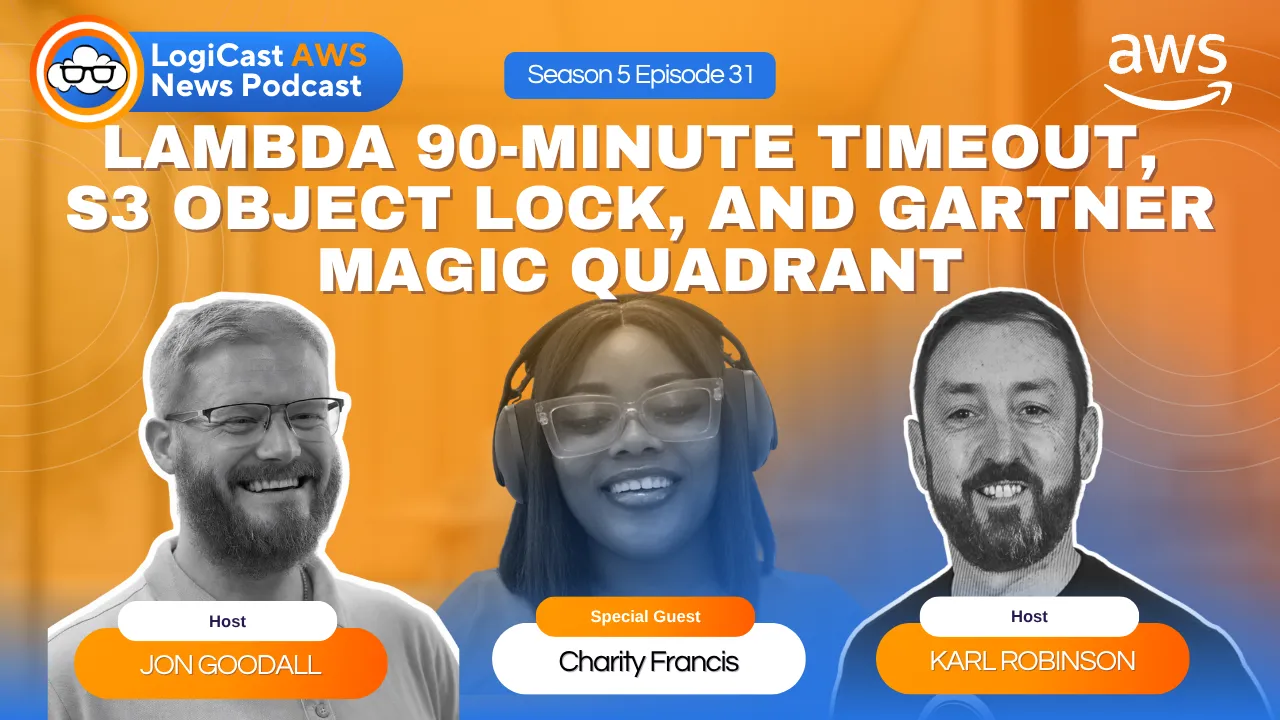
Season 5, Episode 31 of the LogiCast AWS News podcast features hosts Karl Robinson and Jon Goodall of Logicata, joined by AWS Community Builder and cloud instructor Charity Francis. They discuss longer AWS Lambda timeouts, variable retention for S3 Object Lock, improved Systems Manager diagnostics, automated access controls using Budget Alerts, and AWS’s latest Gartner recognition.
AWS Lambda Managed Instances: 90-Minute Timeout
AWS Lambda Managed Instances now support function timeouts of up to 90 minutes, compared with the standard Lambda limit of 15 minutes. The service sits between fully managed Lambda functions and self-managed EC2 instances.
Potential use cases include media processing, AI, ETL, web scraping, financial workloads, and large file transfers. Jon highlighted his podcast post-production pipeline as an example, since transferring and processing multi-gigabyte files can exceed the previous limit.
Asynchronous Lambda Durable Functions can also run for up to one year. However, Charity noted that teams must still consider networking constraints such as NAT Gateway timeouts. The 90-minute limit applies only to asynchronous invocations, so synchronous services such as API Gateway cannot wait that long. The update extends execution time but does not change the surrounding networking fundamentals.
Amazon S3 Object Lock: Variable Retention
Amazon S3 Object Lock now supports variable retention through event holds. Previously, customers could retain objects for a fixed period or place them under an indefinite legal hold. Retention can now begin when a specified future event occurs.
For example, a company may need to retain documents for five years after an acquisition closes without knowing the closing date in advance. An event hold allows the retention period to start automatically when that event occurs.
Charity noted that this could also help healthcare and compliance teams retain records through an audit cycle without guessing when the retention period should begin. Karl added that regulated industries may need to prove both that records were retained for the required period and deleted afterwards. Automating that lifecycle helps organizations meet both obligations.
AWS Systems Manager: Expanded Diagnostics
AWS Systems Manager can now diagnose six additional issues that may cause EC2 instances to appear unmanaged.
Session Manager provides secure instance access without opening inbound ports, but troubleshooting becomes difficult when an instance loses contact with Systems Manager. Administrators may need to check network connectivity, NAT Gateway configuration, agent status, and software versions individually.
Charity said the expanded diagnostics could save engineers from repeatedly checking each possible cause. Although the feature will not resolve every problem, it should make failures easier to identify and shorten the path to recovery.
AWS Budget Alerts: Automated Access Control
AWS has published a pattern for automatically removing a user’s account access when spending exceeds a defined threshold. When a Budget Alert fires, an automated process removes the user’s IAM Identity Center permission-set assignment without stopping the underlying workloads.
Jon explained that this is a documented solution rather than a new AWS feature. It could be useful in large development organizations where exceeding an individual budget should trigger a review rather than simply generate an email.
Charity pointed out that costs may continue accumulating because running resources remain active. Jon agreed, but warned that automatically deleting resources could destroy valuable data. He preferred using the mechanism as a soft lock that prevents further user activity and prompts a review, while leaving cleanup as a separate, deliberate action.
AWS in the Gartner Magic Quadrant
AWS has been named a leader in the Gartner Magic Quadrant for Strategic Cloud Platform Services for the 16th consecutive year. AWS ranked highest for ability to execute, while Microsoft and Google placed ahead on completeness of vision.
Charity attributed the result to AWS’s continued innovation across AI, compute, networking, and storage. Jon agreed with AWS’s strength in execution but questioned a quadrant in which five of seven vendors are categorized as leaders.
He argued that AWS does not always introduce the strongest ideas first, citing Google’s early work on Kubernetes and Microsoft’s early investment in OpenAI. However, AWS has consistently demonstrated an ability to deliver services at scale, with serverless computing standing out as an area where it showed early vision.
Karl also noted AWS’s growing number of discontinued services and the mixed reception of some low-code and consumer-focused products. Despite those concerns, the hosts agreed that AWS’s core services remain strong.
The full episode is available on major podcast platforms and the Logicata YouTube channel.
This AI-generated article is based on LogiCast Podcast Season 5, Episode 31.