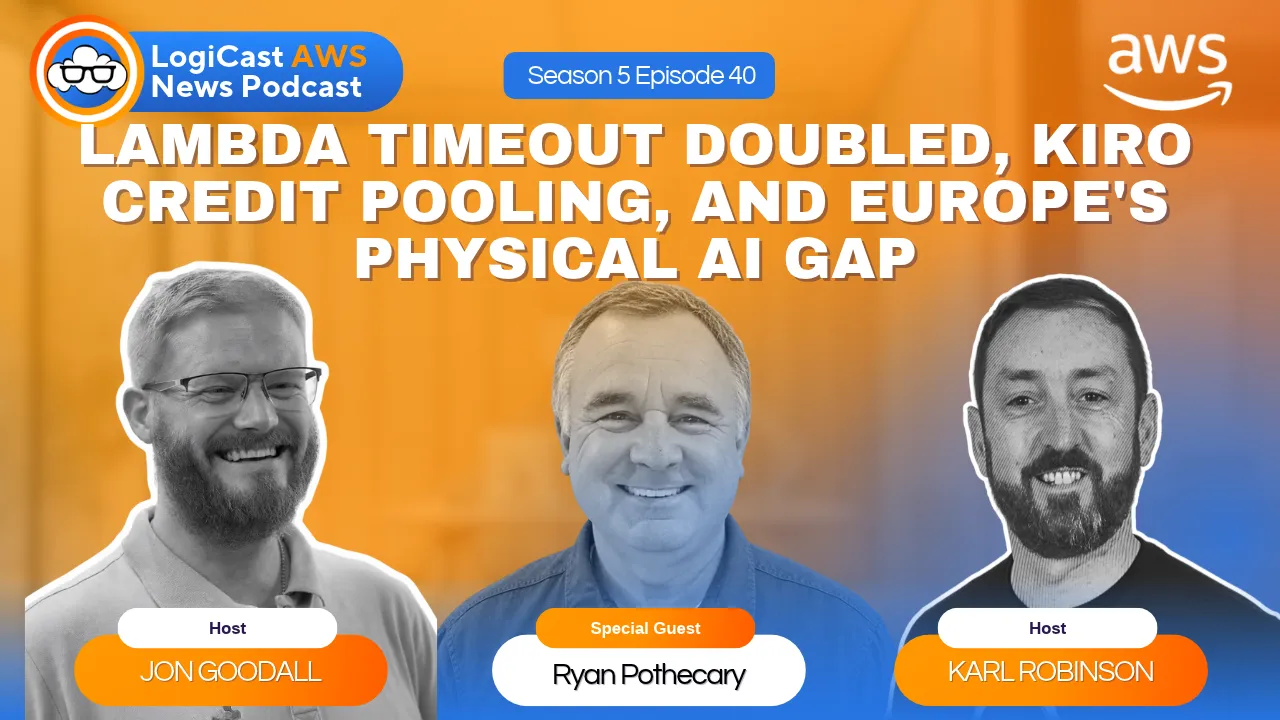
LogiCast AWS News: Lambda Timeout Doubles, RDS MySQL 9.7, Well-Architected Updates, and Kiro Credit Pooling
Season 5, Episode 40 of the LogiCast AWS News podcast features hosts Karl Robinson, CEO and co-founder of Logicata, and Jon Goodall, principal cloud engineer at Logicata, alongside guest Ryan Pothkery, enterprise solutions architect and AWS community builder in his fifth year. The episode covers a Lambda timeout increase, a new RDS for MySQL LTS release, updates to the AWS Well-Architected Framework, changes to Kiro’s credit model, and a broader piece on physical AI investment in Europe.
AWS Lambda Event Function Timeout Extended to 30 Minutes
AWS announced on the Compute blog that the Lambda event function timeout has doubled from 15 minutes to 30 minutes. Jon welcomed the change, framing it in the context of his broader preference for serverless: “I don’t like servers because it’s a thing I have to worry about - what version of stuff is running on it.” He noted that Lambda has had its timeout extended incrementally over the years, starting at around 60 seconds at launch in 2014, then growing to 5 minutes, then 15, and now 30.
The practical benefit Jon highlighted is for medium-length running processes - ETL jobs, batch processing, and data tasks that do not require high-performance compute. He described internal reporting functions at Logicata that iterate over large account estates and had previously required parallelisation work to stay under 15 minutes. “I can now stop thinking about any of those that are kind of at the 10-12 minute mark thinking, oh maybe I should think about that one next.”
Ryan approached it with some initial scepticism, noting that his first instinct was similar to when long-running instances were announced - that it changes the original design intent of the service. He acknowledged that customers are not using Lambda the way it was originally conceived, and suggested the changes may be aimed at helping customers modernise legacy workloads rather than purely serving cloud-native builders. “I think clearly something is not right with that evolution that customers go through from an EC2 migration to containers,” he said, adding that neither he nor Jon had ever particularly warmed to containers the way they had to Lambda.
Jon drew a distinction between three camps: the purists who want small, fast, single-purpose functions; what he called “the Lambdalith crew” who try to run full web servers on it; and pragmatists like himself who define success by achieving one outcome, even if that takes a little time. On whether 30 minutes is enough, Jon was candid: “This is very much a can kick.” He suggested there will still be a place for one-off ECS tasks for jobs that genuinely need hours, and noted that it took around eight years to get from 15 seconds to 30 minutes, so the next increase may be some way off.
Amazon RDS for MySQL LTS Version 9.7 Generally Available
AWS announced on the Database blog that Amazon RDS for MySQL LTS version 9.7 is now generally available. Jon’s reaction was measured - a managed service releasing a new version is, as he put it, “just dull, it’s run of the mill, I just kind of expect a managed service to do this.” The more notable detail for him was that version 5.7 has been extended into further extended support, meaning customers still running it continue to pay what he described as punitive per-vCPU charges.
The practical advice Jon offered was to get onto version 8.4 if currently on 8.0, and then start planning a path to version 9, with 9.7 being the logical destination. He compared the pattern to Kubernetes version management, where teams often find themselves rolling through multiple versions to catch up and then settle on the latest LTS for a few years.
Ryan said this particular product was not one causing him pain with his current customers, but he found the upgrade process itself surprising. “The very traditional infrastructure approach to the upgrade - blue-green deployment, upgrade one side, test it for a little bit, cross fingers, failover, and then upgrade the next side.” He questioned why there was not more automation available, and suggested that the real challenge behind slow upgrades is typically application-level compatibility rather than the database work itself - a lack of developer availability to validate that dependent applications will work with a newer engine version.
Updates to the AWS Well-Architected Framework
AWS published an update to the Well-Architected Framework on the Architecture blog, reducing the number of best practices from 307 to 216 - a reduction of roughly 30% - while claiming no loss of technical coverage. The six pillars remain unchanged: operational excellence, security, reliability, performance efficiency, cost optimisation, and sustainability.
Jon described the reduction as overdue, noting that some questions previously carried ten or twelve best practices each. He also flagged that much of the update is oriented around AI and agentic working patterns - reflecting that teams are increasingly using AI agents to perform tasks rather than doing them manually. He called it “a bit of an AI wash” while acknowledging the trim was justified on its own merits.
A new foundational and workload split was introduced, which Ryan welcomed. He suggested this structure makes well-architected reviews more continuous and practical, particularly during migrations where the foundation needs to be validated before workloads are added. Ryan also noted that his introduction to AWS years ago was through well-architected reviews, and that the service he found most impressive at the time was Trusted Advisor - which he described as sitting in the corner “minding its own business, looking at you disapprovingly from time to time.” His frustration with Trusted Advisor has been that tying it to a support plan removed most of its useful functionality.
The group also discussed a beta Well-Architected agent, which Jon suggested could function similarly to Trusted Advisor but with broader guidance. He proposed, only partly in jest, that it could manifest as a small icon in the corner of the console - drawing comparisons to Microsoft’s Clippy, which the team noted they had made on the podcast before with other AWS AI tools.
Kiro Credit Pooling and Pricing Changes
An article on the AWS DevOps and Developer Productivity blog announced credit pooling for Kiro, framed as an improvement for teams paying through their AWS account. Jon’s summary was blunt: for teams paying via the AWS console, the standard credit cost has doubled from 2 cents to 4 cents per credit, while the included credit allocations per plan tier have halved. The $20 tier previously gave 1,000 credits and now gives 500; the $40 tier has dropped from 2,000 to 1,000. Credit pooling across a team is the offered offset, but as Jon pointed out, even if one team member uses none of their credits, another member still ends up with fewer total credits than they had under the old model for the same spend.
Jon compared it to shrinkflation - the price has not visibly gone up, but what you get has gone down. “Don’t pull the rug out from underneath me and say, but look how soft the floor is that you’ve just fallen on.” He added that the podcast had been anticipating some form of price increase for a couple of months, given that none of these tools are currently profitable. The change only affects teams paying through the AWS console - developers paying by credit card retain the existing tier structure for now.
Ryan agreed the pricing change was frustrating, and pointed out a separate issue in the article: enabling credit pooling requires running Athena SQL queries manually to understand usage across a team. He and Jon both felt this data should simply be surfaced in the Kiro console as a dashboard, noting that AWS already holds the billing data to produce line items. Jon drew a comparison to a similar experience with Amazon Q, where identifying who had triggered a billing overage required significant effort. “My mobile phone bill tells me what I’ve used over the last 6 months on average. It’s not that complicated.”
Physical AI Investment in Europe
The final article, referenced as being about Amazon’s perspective on physical AI in Europe, argued that the sector represents a significant opportunity but that capital constraints are holding back growth from pilot to production. The article was accompanied by images of robots on a car production line, which Jon noted was somewhat misleading - automotive robotics has been largely autonomous for decades, and those machines are purpose-built rather than humanoid.
Jon’s broader observation was that Europe has consistently underinvested in moonshot technology relative to the United States and China, citing cloud hyperscalers, electric vehicle manufacturers, and aerospace as areas where European capital has not shown up at scale. He acknowledged that regulatory frameworks in Europe are more extensive, partly for historical reasons, but suggested this contributes to slower commercial development.
Ryan took a more geopolitical angle, arguing that Europe needs to invest in its own technology base rather than remaining dependent on external providers. He pointed to instances where decisions by large technology companies had directly affected access to services for European institutions and governments. “We can’t just rely on getting all our IT and all our technology from a country - and that’s not anti-American, whatever the country is.” He described the current situation as leverage that could be used against European organisations, and said something needs to change.
One data point from the article that Karl flagged was a finding from physical AI founders that they are using technology primarily to close skills gaps and address labour shortages, rather than to replace human tasks outright. Jon noted that this framing is not necessarily about highly specialised skills - it is more that there are not enough people available to perform certain jobs at the required scale. The group also briefly discussed a wider concern about foundational computing knowledge among new entrants to the industry, with Ryan observing that younger workers coming in often have strong AI tool skills but less grounding in how underlying systems work.
---
The full episode is available on all major podcast platforms and on the Logicata YouTube channel.
*This is an AI generated piece of content, based on the LogiCast Podcast Season 5, Episode 40.*