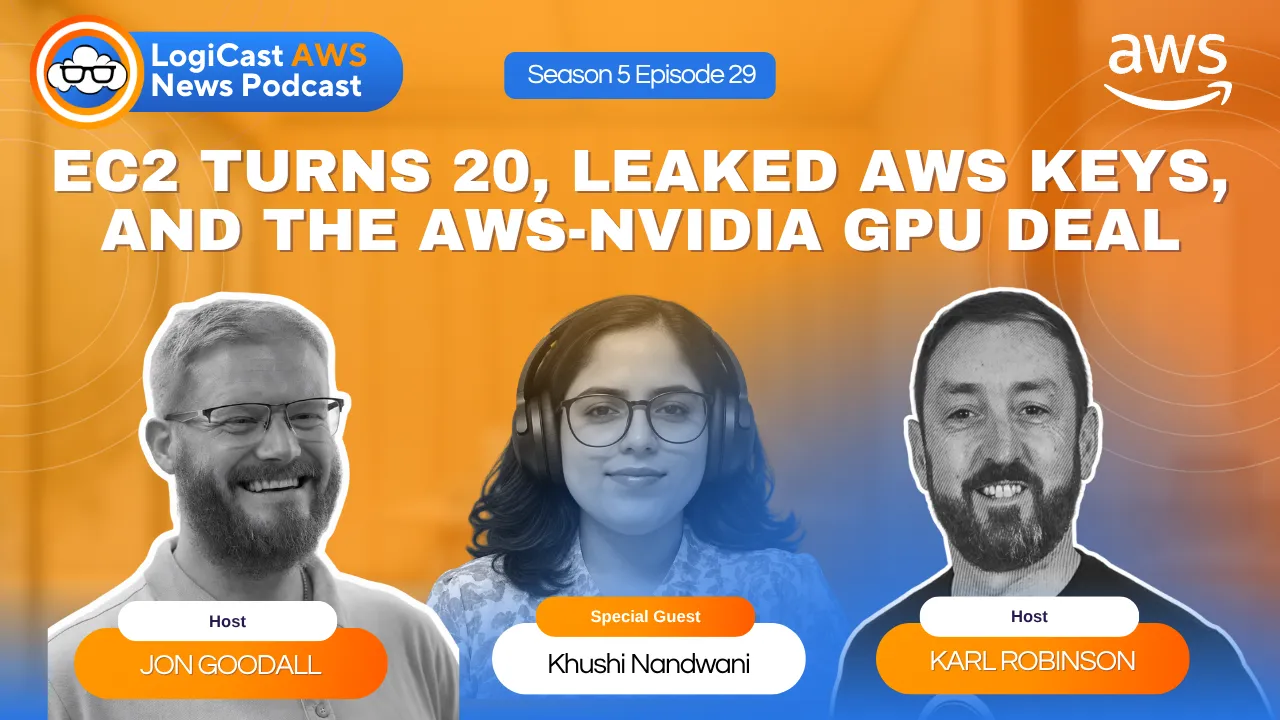
LogiCast AWS News: EC2 Turns 20, Leaked AWS Keys, and the AWS-Nvidia GPU Deal
Season 5, Episode 29 of the LogiCast AWS News podcast features hosts Karl Robinson, CEO and co-founder of Logicata, and Jon Goodall, principal cloud engineer at Logicata, alongside guest Kushi Nandwani, AWS Community Builder in the containers category and recent graduate. The episode covers EC2’s 20th anniversary, a new cost anomaly detection feature for third-party models, the AWS agent toolkit for the CLI, a report on hundreds of leaked AWS keys, and the expanded AWS-Nvidia GPU partnership.
Amazon EC2 Turns 20
Amazon EC2 celebrated its 20th anniversary, and the hosts took a moment to reflect on how far the service has come. Jon noted that EC2 wasn’t technically the first AWS service - that distinction belongs to SQS - but described it as one of the earliest, and traced the trajectory from a single, small instance type to over 1,200 instance types across 39 regions. “You can now reserve 144 specific highly specialised cores on dedicated hardware,” he said. “That’s a bit of a trajectory.”
Jon singled out Graviton as his personal highlight from EC2’s history. The idea that workloads no longer had to run on x86 architecture, and could instead run on ARM for better performance and lower cost, was, in his view, a genuine game changer - though he acknowledged that Apple’s decision to ship ARM chips in its MacBooks helped accelerate broader industry adoption.
Kushi pointed out that while the infrastructure has evolved enormously, the core premise has stayed the same: “The fundamental idea that you can rent compute and pay for what you’re using has still stayed the same.” Karl added that auto scaling was his personal favourite EC2 feature, and reflected that it was EC2 specifically - more than SQS - that made AWS take off, once people realised they could rent server capacity by the hour.
AWS Cost Anomaly Detection and Third-Party Bedrock Models
AWS Cost Anomaly Detection has been updated to support third-party models on Amazon Bedrock - meaning it can now flag unusual spending on models billed through the marketplace, not just native AWS services. Jon’s reaction was blunt: “About damn time.” He pointed out that heuristic-based anomaly detection for unexpected charges has existed in financial services for well over a decade, and questioned why it had taken this long for marketplace spend to be covered.
His theory was that the volume of third-party model usage through the marketplace simply wasn’t high enough to justify it until recently - but now that billing per token for third-party models has become common, the problem has become harder to ignore. Kushi described the feature as a crossover between DevOps and FinOps thinking, noting that knowing how you’re spending on AI - not just how much - is increasingly important.
Karl explained how Logicata configures cost anomaly detection for its customers, using two thresholds that must both be met - a percentage increase and an absolute spend figure - to avoid alert fatigue from small services with volatile but low-cost usage. He also mentioned an outstanding support ticket about unidentified Amazon Q agent spend on Logicata’s own bill, which prompted a wry exchange about which agent might be responsible.
AWS Agent Toolkit for the AWS CLI
The AWS agent toolkit for the CLI has been available for a while, but the discussion touched on why it matters as coding agents become more capable. Jon described the shift from tools like the old CodeWhisperer - “just Intellisense plus a little bit” - through local agents and IDE integrations, to the current state of teams of agents being orchestrated by another agent. The core problem the toolkit addresses is that coding agents only know what’s in their training data, and AWS services change faster than models are retrained.
Jon noted that this shows up practically when an agent needs to validate something it was trained on months ago but which has since changed. “If you’re working in the common services, they’re changing quite often to the point where it doesn’t know how to do that and its training date is only 6 months old,” he said. The toolkit gives agents a way to look up how to interact with AWS rather than relying on potentially stale training data. Kushi, who was briefly dropped from the call due to a connection issue, agreed that the shift from agents that suggest code to agents that can interact with cloud infrastructure directly is significant.
Karl briefly mentioned a related open specification called ARD - Agentic Resource Discovery - which AWS has described as a DNS-equivalent for agents, helping them find the right tools across registries. It wasn’t part of the week’s main articles, but Karl flagged it as one to watch.
Hundreds of Leaked AWS Keys Exposed
A Bleeping Computer report revealed that 817 AWS keys linked to companies had been exposed, with 526 of them being root keys. Of those, 242 were associated with administrator access policies. The oldest key in the dataset had been valid for 17 years, and most had never been rotated.
Jon had practical context here - he had recently tested AWS’s key leak detection deliberately, using a key with no permissions attached to a test account. GitHub flagged the upload multiple times before allowing it, AWS locked the key within roughly 10 seconds, and an event was emitted to EventBridge almost immediately. AWS also sent an email to the account’s security and root contacts and opened a support case. “You can’t honestly claim that you didn’t know,” he said. Karl suggested the more realistic scenario was that notification emails had been going to inboxes that were no longer monitored, or to contacts that had left the organisation and never been updated.
Kushi pointed to basic credential hygiene as the underlying issue - not hardcoding credentials, applying least privilege, and using IAM roles wherever possible. Jon acknowledged that long-lived access keys are still found baked into servers, often because that was once the only option, and that some integration platforms have historically required access keys even when instance profiles were available. The article was published by Truffle Security, whose TruffleHog tool does secret scanning in repositories - something Karl noted gave the piece a degree of self-interest, though he also acknowledged that publishing the findings publicly does at least prompt organisations to check whether they’re affected.
AWS and Nvidia: 2 Million Additional GPUs
AWS and Nvidia announced plans to deliver 2 million additional GPUs between 2027 and 2028, covering next-generation infrastructure for agentic and physical AI workloads. The announcement includes 100,000 GPUs on secure AWS infrastructure for US federal and national security workloads.
Jon’s first observation was that none of this makes life easier for PC gamers, given that AI and, before it, cryptocurrency mining have kept consumer graphics card supply tight for roughly a decade. He also noted that despite the scale of the announcement, he doubted it moved Nvidia’s stock meaningfully - the market has come to expect this kind of growth from the company, and large profit numbers no longer generate much reaction. He raised a manufacturing question as well: with TSMC and Samsung as the only major fab companies producing this silicon, it isn’t obvious where the capacity to build 2 million GPUs is coming from.
Kushi’s focus was on the strategic dimension. The more interesting number to her wasn’t the 2 million GPUs, but what it signals about expected future demand. She noted that AWS developing its own chips - Trainium and Inferentia - is a strategically important decision so that AWS can own its AI compute capacity rather than depending entirely on a third party. Karl echoed that, pointing out that a meaningful portion of those 2 million GPUs may already be committed to specific customers and projects, given the scale of the federal contract mentioned in the announcement alone.
---
The full episode is available on all major podcast platforms and on the Logicata YouTube channel.
*This is an AI generated piece of content, based on the LogiCast Podcast Season 5, Episode 29.*