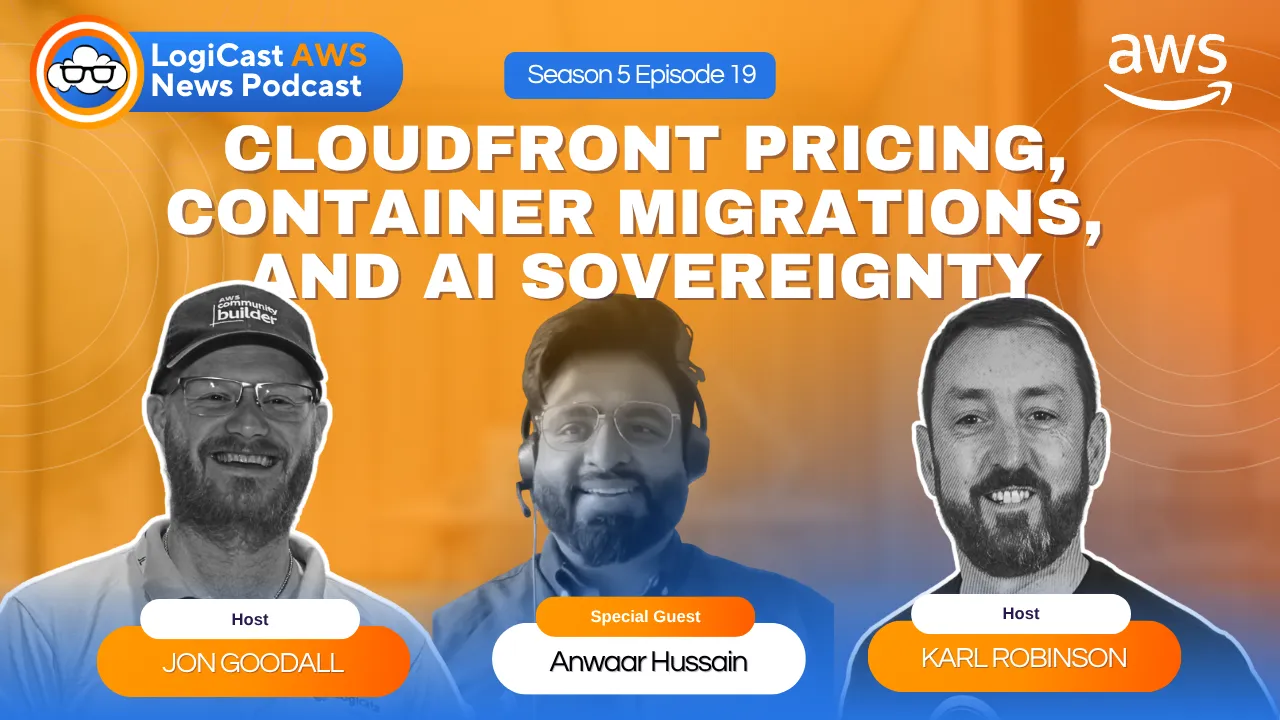
LogiCast AWS News: CloudFront Pricing, AWS Transform Containerization, and the Evolution of AI-Powered Development
Welcome to the latest installment of the LogiCast AWS News Podcast roundup. In this week’s episode, Karl Robinson and Jon Goodall of Logicata were joined by Anwaar Hussain from AWS Professional Services to discuss some of the most significant developments in the AWS ecosystem. From pricing innovations to AI-driven transformation tools, the conversation touched on topics that are reshaping how organizations approach cloud migration and development. Let’s dive into the key takeaways from Season 5, Episode 19.
The Evolution of CloudFront Pricing: Closing the Gap for All Organizations
The episode began with a discussion of CloudFront’s expanded premium flat-rate pricing plans, which represents a significant evolution from the initial launch. According to Jon, the original announcement introduced tiered pricing options that, while compelling, had limitations. “The delineator between the tiers was requests, I think, but you had the same egress and you had this, the number of the other features were the same,” Jon explained. “The number of requests were the same regardless of the tier you were on, which biased people towards larger numbers of smaller requests or smaller numbers of larger requests, and then you could very easily outgrow it.”
With the latest update, AWS has made these plans significantly more flexible. Organizations can now scale from 500 million to 6 billion requests and from 50 terabytes to 600 terabytes of data transfer, while maintaining the predictability of flat-rate pricing. This represents a crucial shift in the market dynamics.
Karl highlighted the financial importance of this development: “The frustrating thing is you can’t preset it to kick in when your savings bundle expires, so you’ve kind of gotta sit and wait, but you’ve got more options now and more options is good.” John added that flat-rate pricing appeals to finance departments for a fundamental reason: predictability. “Finance departments don’t necessarily care what the number is, they care about what it’s going to be ahead of time so that they can forecast it,” he noted.
Anwaar speaking from his experience in AWS Professional Services, saw significant practical benefits. “Definitely it will massively help AWS support because in the past, there were some procurement delays in case you needed more high numbers of request count and you wanted higher data transfer rates,” Anwaar observed. “So that will reduce friction between the support team and the actual user of AWS cloud.”
The expanded pricing options particularly benefit mid-market enterprises. As Anwar pointed out, organizations that previously couldn’t access premium pricing features can now benefit from bundled services at flat rates. This democratization of pricing is helping to close the gap between SMBs and fully enterprise deployments.
AWS Transform: Bringing Containerization Into the Migration Process
One of the most exciting announcements from the week was AWS Transform’s new containerization capability during migrations. Rather than treating containerization as a post-migration task—something organizations typically delay indefinitely—AWS has integrated this transformational step directly into the migration process using AI.
“I was wondering why it didn’t take place earlier,” Anwaar said, reflecting on the announcement. “In the past, there was a bit of a gap—OK, what if we want to modernize it, re-platform it? For re-hosting, it was a very good solution, but there was a final destination missing—going serverless or containerizing it so you’re fully re-platformed.”
The comprehensive nature of Transform’s containerization capability is impressive. The service analyzes source repositories from GitHub, Bitbucket, GitLab, or zip files, generates Dockerfiles, builds images with vulnerability scanning, pushes to Elastic Container Registry, and deploys to EKS or ECS—all end-to-end.
Jon acknowledged the “lunch eating” aspect of this announcement—the reality that such automation will disrupt existing business models. “I’d have killed for this service 18 months ago in the middle of a containerization project that was just hard. It was just hard,” he admitted. “I don’t know how perfect this will be because it’s all AI based and you’re still gonna have to do a lot of the legwork yourself, but it’s gonna take that monkey work out effectively, it’s gonna take the grunt work out.”
However, Anwaar offered a balanced perspective on how professional services firms can adapt. “It will definitely eat some of our lunches, but I think in a way like it will also augment and complement our work. In the past, we’ve done significant migrations for UK public sector customers, and it was always a bit of a challenge with outdated technologies. I think it will bring down what would take months to a few months at least. Massively helpful. And once the transformation is done, we can do more innovative stuff in the AI and GenAI space.”
Karl emphasized that while Transform handles the technical work, there remains demand for expertise in helping organizations understand and manage migrations. “The demand isn’t going to go away. The demand is gonna change,” he suggested. “What we’re gonna see, I think, is an acceleration of migrations out of their server room, their cupboard, their kind of ‘oh, our website runs under my desk’ into the cloud, so we’re gonna see an acceleration of that and maybe more demand in the mid-market space for people to help with that.”
Kiro’s Requirements Analysis: Closing the Gap Between Specification and Implementation
The conversation then turned to Kiro, AWS’s AI-powered coding assistant, and specifically its new Requirements Analysis feature. Karl, who describes himself as an “accidental app developer,” recently used the feature to develop an application. “I’ve never written a line of code in my life, but now I’m cranking it out with Kiro and it’s fantastic,” he said. “I generated 27,000 lines of code in two hours.”
Jon has been particularly aggressive in his adoption of Kiro. “We’re at the 19th and I’ve used all of my monthly credit allowance of 1,500 credits plus a 500 credit Star Wars promo bonus, and I’ve gone 300 over my limit,” he revealed. “I’ve already used 1,850 credits in 2.5 weeks, so yeah, I’m hard into Kiro.”
The interesting aspect of Jon’s consumption isn’t just the volume—it’s what he’s accomplished. He’s built an export tool for PDFs to emerge from their wiki with branded formatting, and an AI code review bot. Work that would have taken him “days and days and days” was completed in “a day and a half.”
When discussing the Requirements Analysis feature specifically, Jon highlighted how it addresses a fundamental challenge with AI: optimization bias. “AI is fantastic, but it optimizes for the one, it struggles with overcomplexity, and two, it optimizes for the highest throughput use case it can imagine,” he explained. “A lot of the things that we build tend to be fairly low throughput, so we need to think about making sure that we can handle throughput.”
The Requirements Analysis feature uses what Anwar described as a “neurosymbolic pipeline”—translating requirements into logical format, passing them to an SMT solver to identify contradictions mathematically, and then presenting those potential issues back to developers in plain language. “The emphasis should be on solid prompt engineering,” Anwaar cautioned. “As long as the requirements are not tightened up, as long as human intervention is not involved, there is a chance that we will keep on producing below-par code that could lead to serious issues.”
The feature also includes parallel task execution and quick plan mode. According to Jon, parallel task execution determines what work can be completed simultaneously and shows dependency trees between tasks. Quick plan mode appears to sit between full specification mode and “vibe coding” mode, asking more questions upfront to better understand requirements.
However, the conversation also highlighted concerns about sustainability. Karl asked the fundamental question: “How long are we gonna be able to do these things at this price? Are monthly allowances going to shrink? Is it gonna be more credits to do a thing?” He introduced the concept of “token shrinkflation”—where the cost per token remains the same, but more tokens are required to accomplish the same work.
Anwaar suggested the field is evolving rapidly, with customers still catching up on AI policy and governance. “We should be mindful of what we are asking from these AI data sources, and what we are using it for,” he advised. “Some customers are still a bit behind on AI policy, but AWS is giving them assurances that solutions are reliable and have been catering to AI requirements with added layers of regulation.”
AI Sovereignty: Establishing Trust in a Rapidly Evolving Landscape
As organizations accelerate their adoption of AI tools, concerns around data sovereignty, residency, and operator access have become increasingly important. AWS addressed these concerns in a blog post on enabling AI sovereignty, authored by Stefan Israel, who runs the AWS European Sovereign Cloud.
According to Anwaar, this announcement represents an important assurance layer. “This feels like an addendum to what AWS has already committed, like the digital pledge from 2022 that all AWS users have control over where data resides,” he explained. “This is mindful of AI challenges that customers may have and provides the right language that’s helpful when having conversations around AI adoption with customers who are completely up to date on AWS but still reluctant to adopt AI because of missing policies and understanding concerns.”
One particularly interesting aspect of this announcement is AWS’s achievement of ISO/IEC 42001 certification, becoming the first major cloud provider to obtain this international standard for responsible AI. “I think this is where AWS is gonna win because of their scale,” Karl suggested. “They know all these things and they can very rapidly acquire any new certifications and standards that are coming out to give those extra assurances.”
Jon noted that the complexity of AI governance extends beyond traditional data residency concerns. “When you start looking at how inference works on AWS, particularly with more recent models, it can run in any capacity location you have, so you might want your inference to run in Stockholm for whatever reason,” he explained. “Most of the issues I’ve seen around AI sovereignty have been around the nationalities of the companies providing the models rather than where they’re running.”
One notable element of the announcement is AWS’s approach to cultural and linguistic considerations. “With the advent of AI and how rapidly it has grown, some catchup needs to be done,” Anwaar observed. “AI comes up with an additional layer of complexity—meeting cultural norms and local languages that may not have been concerns with traditional data sovereignty in Europe. But now it boils down to different languages and different cultures because that’s how they interact with foundational models and what outputs they access.”
Data Center Thermal Events: A Timely Reminder About Resilience
The final article discussed was a Mashable piece covering AWS’s disclosure of the May 2026 North Virginia outage. The cause? A thermal event—which Karl joked about with the UK experiencing a weather-related thermal event forecast for the weekend.
The outage, while affecting some customers, remained isolated to a single data center within a single availability zone in North Virginia. Jon put the incident in perspective: “These are, stuff runs in data centers. Data centers have hardware, hardware breaks. In other news, water continues to be wet.”
However, the incident provided an important reminder about the necessity of multi-availability zone architecture. “This is not a region outage,” Karl clarified. “This is a single isolated event in a single availability zone or data center within an availability zone.”
Anwaar emphasized the practical implications: “This is a nice little reminder for everyone that we should review our architecture and make sure we’re not reliant on a single layer. Quarterly or as frequently as possible, we should review our applications to ensure we have replication in place and backups.”
Karl added a crucial point that’s often overlooked: “Test it. Give yourself the assurance that it actually works. So, in the event that you are unlucky enough to be affected by one of these events, you will know that it will work. You’re not just crossing everything and hoping that these things will work when they’re needed.”
Anwaar concurred, noting a troubling pattern he’s observed: “We have seen in practice that in spite of taking backups, those backups are never tested—how long it will take to restore those backups and make your business or infrastructure operational. So any sort of drill on a regular basis to make sure you can restore your business and meet your SLAs and all other KPIs is essential.”
Conclusion: A Rapidly Evolving Ecosystem
This episode of LogiCast covered ground that reflects the rapid evolution of the cloud and AI landscape. From pricing innovations that democratize access to cloud CDN services, to AI-powered tools that are transforming how applications are developed and migrated, to emerging frameworks around AI sovereignty and governance, the AWS ecosystem continues to evolve at a breakneck pace.
The perspectives shared by Jon and Anwaar - representing both the consulting and AWS professional services sides - illustrate that while AI and automation are changing the nature of cloud work, the demand for expertise, guidance, and verification remains strong. The key is adapting to what’s changing while maintaining focus on fundamental principles: predictable costs, resilient architecture, solid security practices, and thorough testing.
As Karl concluded, organizations that stay informed about these developments and adapt their strategies accordingly will be best positioned to leverage these new capabilities for competitive advantage.
---
*This is an AI generated piece of content, based on the Logicast Podcast Season 5, Episode 19*