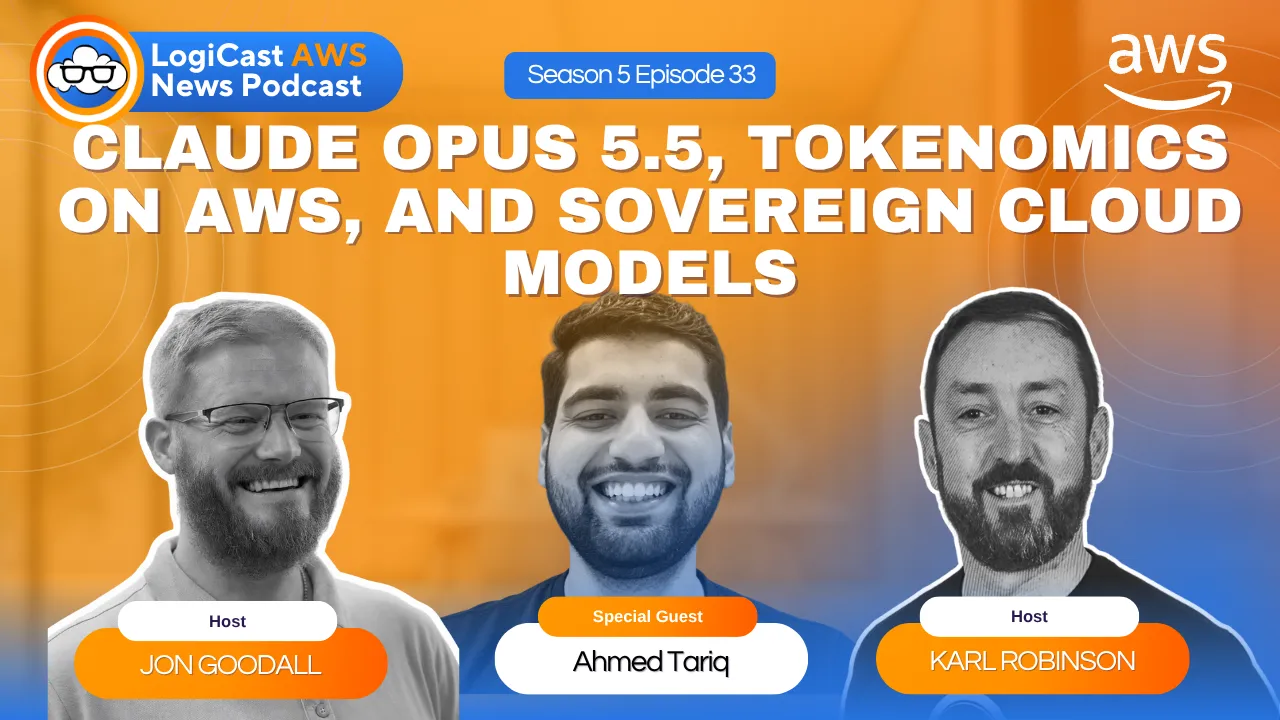
LogiCast AWS News: Claude Opus 4.5, Tokenomics on AWS, Sovereign Cloud Models, and More
Season 5, Episode 33 of the LogiCast AWS News Podcast features hosts Karl Robinson, CEO and co-founder of Logicata, and Jon Goodall, principal cloud engineer at Logicata, alongside guest Ahmed Tariq, cloud platform engineer and AWS community builder.
The episode covers Claude Opus 4.5’s availability on AWS, a new AWS guide to tokenomics, open weight models in AWS European Sovereign Cloud, DevOps agent integration with Amazon Managed Service for Prometheus, and a community article on human bottlenecks in AI workflows.
Claude Opus 4.5 on Amazon Bedrock and Claude Platform on AWS
Anthropic’s Claude Opus 4.5 is now available both through Amazon Bedrock and through the Claude platform on AWS, accessible via AWS Marketplace. Jon opened by revisiting a familiar complaint - Anthropic’s naming conventions - though he acknowledged that a point release like 4.5 is easier to accept than the infamous “Sonnet 3.5 version 2”.
The more substantive discussion centred on what “Claude platform on AWS” actually means in practice. Karl clarified that while it is accessible through Marketplace and integrates with IAM credentials, the data processing boundary extends outside of AWS - outside your VPC, your account, your organisation structure. “There may be other models, versions, etc. that are not available in Bedrock, which would be available in Claude platform on AWS so you can still pay for it and access it with your AWS credentials,” he noted, framing it as a pragmatic option when Bedrock lags on model availability. Jon’s preference remains firmly with Bedrock, where Amazon runs the model entirely themselves without routing back to the model provider.
Ahmed had used Opus 4.5 directly and found Anthropic’s claims of around 40% lower cost and 30% faster performance to be broadly true, but workload-dependent. “For complex tasks, for multi-agentic tasks, I think Opus 4.5 is good,” he said, while noting that for smaller tasks lighter models are often sufficient. He also flagged that hallucination remains a factor, and that the model’s tendency to spin up a cluster of agents for simple tasks is something to watch.
Jon pointed to a broader trend he has observed across model generations: token costs fall, but models use progressively more tokens, so the net spend stays flat or rises. Opus 4.5 claiming genuine efficiency gains on both fronts would be a meaningful shift if it holds up. “It doesn’t seem to be happening yet” - the feared cost explosion - was his measured conclusion.
Tokenomics on AWS
A post on the AWS Cloud Financial Management blog introduced what AWS is calling tokenomics - applying cost attribution and return-on-investment thinking to AI token usage, in a similar way that FinOps applied those disciplines to cloud spend generally. Jon was characteristically sceptical of the terminology but acknowledged the underlying need is real.
The practical core of the announcement is that the Cost and Usage Report 2.0 can now break out inference costs by IAM principal, allowing teams to attribute token consumption back to specific workloads, users, or services - though Jon noted this applies to direct Bedrock invocations and likely does not surface spend from tools like Q or Kiro, which appear as their own line items. The article covers three areas: visibility into who is consuming tokens, optimisation techniques including more precise prompting, and governance and ROI measurement.
Ahmed drew a direct comparison to work he had done in Azure, where similar token attribution required implementing a full LLMOps pipeline and was, in his words, “quite hectic”. He sees the AWS approach - combining IAM principal attribution, workload tagging, and invocation logging - as a simpler path to the same goal.
Karl raised the ROI framing explicitly. “Without having that visibility into token usage, it’s impossible to demonstrate the ROI,” he said, adding that while token costs are currently low enough that many organisations are not yet scrutinising spend closely, that will change as AI deployment scales. The article’s guidance to define the problem and success metrics before starting any AI project was highlighted as the most practically useful takeaway.
Open Weight Models on Amazon Bedrock in AWS European Sovereign Cloud
AWS has made a small set of open weight models available on Amazon Bedrock within the AWS European Sovereign Cloud, currently the four Gemma 4 family models from Google. Jon acknowledged he had to look up what “open weight” means - the model weights are publicly released, so they can be inspected and downloaded - and described it as essentially a new label for open source.
The Sovereign Cloud context is what makes this notable. Jon explained that the partition separation between Sovereign Cloud and the standard commercial AWS regions is deliberately difficult to bridge, and AWS has made contractual commitments to contest any US Cloud Act requests. “That’s about as good as you can get while still being in the Amazon ecosystem,” he said. The combination of inspectable model weights and a genuinely isolated sovereign environment addresses a set of concerns that tend to travel together - organisations worried about US government oversight of data tend also to want the ability to examine how the models they are running actually work.
Ahmed made a practical point worth noting: the availability of a service or model in standard AWS regions should never be assumed to carry over automatically into the Sovereign Cloud environment. Architecture for sovereign deployments needs to be evaluated against what is actually available within that boundary. He also clarified that running open weight models in this context does not mean managing your own GPU infrastructure - AWS still hosts and manages everything; “open weight” describes the licensing and transparency of the model, not the deployment model.
Jon observed that Sovereign Cloud is behaving increasingly like a tier one region in terms of what it supports, including using the OpenAI-compatible Bedrock endpoint rather than the older Converse API. He described AWS as “threading the needle” on the sovereignty question given the US parent company context.
Root Cause Analysis with Amazon Managed Service for Prometheus and AWS DevOps Agent
An AWS Cloud Operations blog post covered integrating Amazon Managed Service for Prometheus with AWS DevOps agent to support root cause analysis for EKS workloads. The integration gives DevOps agent another signal source - metrics from Kubernetes environments - to use when investigating incidents.
Jon’s response was positive in principle but came with a pointed observation about how DevOps agent is typically demonstrated. “They’re always happy path investigations,” he said. “It’s ironic for an incident.” The demos tend to show single workloads in clean, well-configured accounts. In practice, a Kubernetes cluster might be running many workloads, and production accounts frequently do not follow best practice in terms of separation. His concern is that DevOps agent is still incorrectly correlating unrelated failures - treating two things that happen to fail simultaneously as causally linked when they belong to entirely different workloads. The Prometheus integration itself involves a fair amount of setup work, which Jon noted is fairly typical for Kubernetes generally.
The discussion widened from there into the broader question of whether AI tooling is displacing junior engineers, prompted by the nature of what DevOps agent is doing - the kind of log investigation and first-line diagnosis that would traditionally be a junior engineer’s learning ground.
Ahmed described the situation among students and new graduates as genuinely difficult. Junior roles are shrinking as companies freeze hiring, and the students he mentors are confused about which direction to go. “The basic stuff is already being done by AI,” is the message they bring back to him, and as a result some are skipping foundational skills on the assumption that AI will handle them. He flagged this as a compounding problem: fewer juniors now means fewer seniors in ten years, and no one has a clear answer for how to bridge that gap.
You’re Still the Bottleneck - Allen Helton, Ready Set Cloud
The final article, written by community contributor Allen Helton on his Ready Set Cloud blog, argues that humans remain the limiting factor in AI-assisted workflows despite the enthusiasm for running large numbers of parallel agents.
Jon had read this one in full, which he acknowledged is not his norm, attributing it partly to Helton being a genuinely engaging writer. The core argument resonated with Jon’s own experience. Running many agents simultaneously creates constant context switching, and the overhead of tracking what each one is doing quickly becomes unmanageable. “I want to sit there and I want to work with it. I want to look at the outputs. I want to make sure I know what it’s doing,” he said.
His exception is when a single agent spawns sub-agents that it manages internally, so the human is still dealing with one interface - but tools that encourage running many independent agents in parallel were not something he found appealing.
Ahmed framed the token consumption angle through the junior-senior lens raised earlier in the episode. A junior engineer without the technical context to write precise prompts will consume far more tokens reaching the same output as a senior who can frame the problem clearly and concisely. That gap, combined with multi-agentic models that default to spawning additional agents for tasks that do not require them, makes the token consumption problem worse rather than better.
Karl’s closing thought was that AI tools - coding assistants in particular - tend to enable more plates to be spun faster, rather than reducing the number of plates. That is not straightforwardly a good thing, and it connects back to the tokenomics discussion: as AI usage scales across large teams, visibility and governance become urgent rather than optional.
The full episode is available on all major podcast platforms and on the Logicata YouTube channel. If you found it useful, a rating or subscription helps the show reach more listeners.
This is an AI generated piece of content, based on the LogiCast Podcast Season 5, Episode 33.