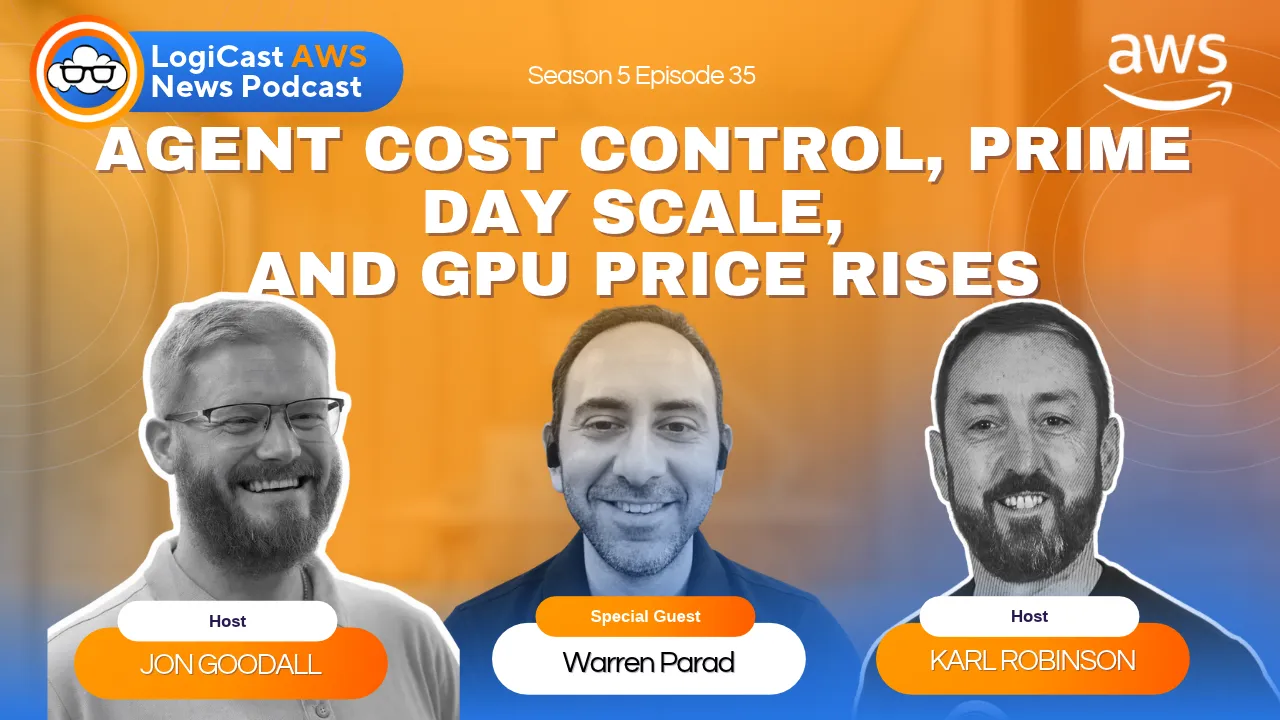
LogiCast AWS News: AWS Capabilities by Region Updates, Continuum Penetration Testing, DevOps Agent Cost Controls, Prime Day Infrastructure Numbers, and GPU Price Rises
Season 5, Episode 35 of the LogiCast AWS News Podcast features hosts Karl Robinson and Jon Goodall of Logicata alongside returning guest Warren Parad, CTO of Authress. The episode covers five AWS topics: updates to the Capabilities by Region tool, continuous penetration testing in CI/CD pipelines via AWS Continuum, cost controls for the DevOps agent, the annual Prime Day infrastructure stats post, and a rise in reserved GPU pricing.
AWS Capabilities by Region - Availability Notifications and Advanced Filters
AWS has added availability notifications and advanced filtering to its Capabilities by Region tool, including the ability to filter on API operations and CloudFormation availability. Jon was direct about his take: the announcement itself is not particularly interesting for engineers working primarily in what he described as tier one regions - London, Ireland, US East and West, and the major APAC hubs - because those regions tend to have everything relevant already available. The feature is more useful, he said, for people working in regions that do not have full service coverage.
What Jon found more telling was that CloudFormation availability is now something you can filter on at all. “A parody Santa’s wishlist that I saw about 7 years ago” had day one CloudFormation support as a wish list item, he noted, suggesting the problem is longstanding. His broader point was that new services should ship with more than just console support - and in some cases, even console support is not guaranteed.
Warren offered a different angle. He questioned whether the filtering capability actually matches how engineers approach multi-region work in practice. In his experience, teams running across many regions do not make upfront architectural decisions based on a capabilities matrix - they deploy incrementally and discover gaps as they go. The notification side of the feature, though, he found more genuinely useful. Knowing when a feature you care about has become available in your region - without having to wait for re:Invent or stumble across a blog post - has real value, particularly for teams that want to stay current on what AWS is releasing.
Karl raised the multi-region build scenario, pointing out that if you are developing an application intended to run across regions from the start, you need to know which features are and are not available everywhere. Warren agreed in principle but noted that in practice, no one does the waterfall-style planning required to make full use of that upfront. You find out about the gaps when you hit them.
A brief side discussion touched on CloudFormation’s relationship to the underlying API. Jon noted that CloudFormation does not go via the public APIs in the same way Terraform does, which is why Terraform can be rate limited and CloudFormation typically is not - though Warren pushed back slightly, pointing out that CloudFormation does have its own rate limits at a lower layer, and these can surface in CI/CD pipelines with newer or recently enabled services.
The Capabilities by Region tool lives in AWS Builder Center rather than the AWS console. Karl noted that you do not need to log in to view it, though a Builder ID is required to register for events and access other Builder Center features.
AWS Continuum for Penetration Testing - CI/CD Pipeline Integration
AWS Continuum - formerly known as Security Agent - now supports continuous penetration testing integrated into CI/CD pipelines. The product has also been split into distinct flavors, including Continuum for Penetration Testing and Continuum for Vulnerability Scanning. Jon acknowledged the naming is getting complicated, comparing it to the various branded tiers of Amazon Q.
Jon was broadly positive about the underlying capability. The pitch is that automated penetration testing as a post-deployment gate can catch low-hanging-fruit issues quickly and cheaply, without replacing a formal penetration test conducted by accredited testers. “Those things are not cheap,” he said of formal pen tests, “and you kind of want the pen testers to be doing the higher value, higher order stuff.” The service is currently in public preview, which typically means no cost, and Jon suggested it is worth exploring now before pricing is confirmed at general availability.
Warren approached it from a compliance angle. He questioned whether the filtering and scanning capabilities match what people working in constrained regions actually need, and noted that the current standard of annual security reviews is likely to become inadequate as automated exploit tooling becomes more capable. He referenced a recent case involving a bot on an Ethereum sidechain that intercepted and completed another attacker’s exploit mid-execution, making off with around $7.8 million, as an illustration of how fast the threat landscape is moving.
His longer-term view was that services like Continuum will eventually be required rather than optional - insurance and compliance frameworks will catch up and demand continuous evaluation of the supply chain. But he was also candid that the output, as it stands, does not yet carry the weight of a third-party audit. “I’m still waiting for a minted and stamped report by AWS that says it’s authentic that you can share with potential customers,” he said. Until AWS can provide that kind of attestable output, teams will still need to pay external auditors - often granting them access to systems that those auditors may not fully understand. Warren saw closing that gap as the meaningful next step.
AWS DevOps Agent - Upfront Investigation Cost Controls
A post on the AWS Cloud Operations blog outlines a mechanism for getting upfront cost estimates before an AWS DevOps Agent investigation runs, framed as a way to prevent unexpectedly expensive agent executions - particularly in cases where an agent might issue an unbounded Athena query across years of data.
Warren’s initial reaction was sceptical. He questioned how useful a hard cost figure actually is in practice. If an investigation is estimated at $200, most engineers are unlikely to cancel it - and if it comes back at $10,000, the more appropriate fix is a cost ceiling, not a prompt. His deeper concern was that the skill exists to paper over a problem the agent should not be causing in the first place: “It’s filling a gap that is caused by the agent, and we’re paying for it.”
Jon drew a distinction between two types of investigation scenarios. For a P1 incident - something actively broken in production - he argued there should be no budget limit at all, because the cost of waking engineers at 2am or burning them out over time far exceeds token spend. For lower-priority background work - the kind of routine triage that might historically have gone to a junior engineer - a cost boundary makes more sense. “This should not cost me more than the variance that you’ve found to work out what the variance is,” he said.
Warren agreed with the P1 framing but argued that the fundamental issue is the agent’s approach to investigation. A good debugging process is iterative - you start with what you know, gather evidence, and adjust. Asking an agent to produce an upfront execution plan before it has seen any data is a waterfall approach applied to a problem that does not suit it. He felt the more meaningful improvement would be making the agent smarter about scoping its own queries, rather than adding a skill to catch the cases where it gets it wrong.
AWS Prime Day 2026 Infrastructure Numbers
Amazon published its annual post detailing the infrastructure scale behind Prime Day, continuing a tradition that has run for around a decade. The numbers are large enough that Jon’s standout figure was CloudWatch processing over 2.15 quadrillion metric observations. “You don’t often hear quadrillions,” he said, before running through a quick analogy: one quadrillion seconds works out to around 31 million years.
Warren’s response was more pointed. Without knowing what those workloads actually cost - accounting for internal chargeback mechanisms and private pricing agreements between Amazon retail and AWS - the numbers are difficult to reason about. He raised a past example of a video streaming microservice that moved off Lambda because the cost was unsustainable, noting that these are the kinds of decisions the raw figures do not illuminate.
Karl was direct: “This is a sales tool.” The implicit message in publishing these numbers is that if AWS can run Amazon on Prime Day and Netflix’s control plane simultaneously, it can handle your workload. Jon noted the Netflix qualifier - AWS runs Netflix’s control plane, not the video streaming itself, which Netflix handles through its own infrastructure partly because egress costs at that scale would be prohibitive.
The group discussed whether Amazon itself pays anything close to standard AWS rates, concluding that while there is almost certainly some internal chargeback mechanism, it is not the same as metered public pricing. Warren pushed back slightly, arguing that internal cost tracking is genuinely important at scale - not because the dollars are real in the same way, but because without it, organizations lose the ability to make rational investment and resource decisions across business units.
Nvidia GPU Reserved Instance Price Rise
AWS has raised prices on reserved Nvidia GPU instances, the second such increase discussed on the podcast. Jon traced the underlying pressure to the concentration of chip manufacturing - TSMC in Taiwan and SK Hynix in South Korea account for the bulk of production, and current geopolitical and trade dynamics are feeding through to input costs.
Warren framed it as a supply constraint playing out predictably. The number of chip manufacturers has been limited for over a decade, demand is increasing as more of the economy shifts toward compute-intensive workloads, and prices have to reflect that eventually. He also noted that GPU costs are now a matter of broad public awareness in a way that large EC2 instance pricing never was, which is why the market reacts more visibly.
The group noted the apparent paradox of Nvidia posting record quarterly profits and seeing its stock price dip, which Warren explained straightforwardly: if the result was already priced into expectations and the actual number did not exceed those expectations, the price adjusts to reflect the revised outlook.
Karl raised whether the Nvidia price rise might be partly designed to make AWS’s own Trainium chips more attractive by comparison. Jon thought it was plausible - AWS has used both carrots and sticks to push customers toward Trainium, including investment arrangements where companies commit to purchasing Trainium compute. “Maybe that’s the carrot,” he said of those deals. “Maybe this is the stick.”
---
The full episode is available on all major podcast platforms and on the Logicata YouTube channel.
*This is an AI generated piece of content, based on the LogiCast Podcast Season 5, Episode 35.*