LogiCast AWS News: Amazon Leo, Mechanical Turk's Retirement, Kiro Turns One, and Free AWS Sandboxes
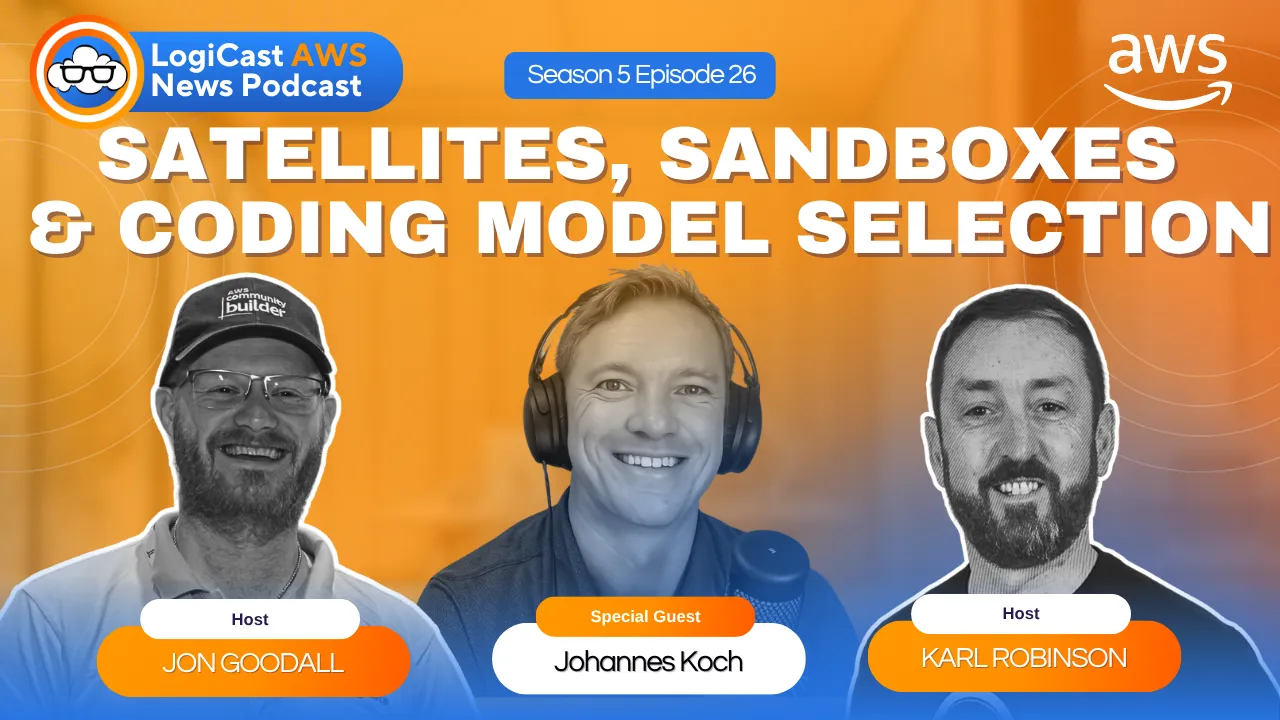
Welcome back to another edition of the LogiCast AWS News blog, based on Season 5, Episode 26 of the podcast. This week, host Karl Robinson and co-host Jon Goodall of Logicata were joined by returning guest Johannes Koch - AWS hero and community leader - for their 5th time together on the show. Before diving into the news, Jon revealed his recent attendance at a My Chemical Romance gig at Wembley, belting out songs alongside 90,000 fellow fans, which explains the episode’s rather apt opener about teenagers being scary. With that out of the way, the trio got stuck into some genuinely interesting AWS and tech news.
Amazon Kuiper - A Long Way Behind Starlink
The first article up for discussion was a CNET piece covering Amazon’s Kuiper project - the company’s low Earth orbit satellite broadband service, often described as its Starlink competitor. The article claimed that Kuiper is ready to begin limited internet service later this year, but acknowledged the significant ground Amazon still needs to make up.
Jon didn’t hold back on sharing his thoughts, launching into a detailed and enthusiastic explanation of the orbital mechanics at play. “Starlink completely changed the game,” he said, explaining that traditional satellite broadband relied on geostationary satellites - much further away from Earth and offering higher latency as a result. Starlink’s low Earth orbit approach brought satellites much closer, dramatically improving speeds and latency, but requiring thousands of satellites to maintain coverage - what the industry calls a “constellation.”
“Having never met either of them, it’s - I sound like a socialist now,” Jon noted wryly when discussing the prospect of yet another billionaire-backed venture needing a competitor, referencing both Elon Musk and Jeff Bezos in the same breath.
Johannes pointed out some telling numbers: Starlink currently has around 10,000 satellites in orbit, while Kuiper is aiming for 7,700 by 2035 - still nearly a decade away. “It really sounds like they are still trying to catch up here,” Johannes observed. He also floated an interesting alternative perspective on Kuiper’s potential, suggesting it may not be aiming directly at the consumer market at all. “I would say Leo is stronger for enterprises and for actually connecting enterprise workloads wherever they are in the world,” he said, noting the potential for private use cases - particularly if Kuiper could be offered as an add-on to existing AWS services.
Karl pointed to JetBlue and Delta Airlines as companies already contracted with Kuiper, and suggested the combination of Outposts and Kuiper on ships, oil rigs, or in deep ocean research settings could be a compelling proposition. Jon agreed, acknowledging that with only around 396 satellites currently in orbit, Kuiper will need to be selective about where it actually delivers service for now.
Amazon Mechanical Turk - A Quietly Forgotten Service Fades Away
Next up was a piece from The Register reporting that Amazon’s Mechanical Turk (MTurk) is to stop accepting new customers, with the article suggesting that not even AI could save it.
The reaction from all three was fairly telling - none of them had really been paying attention to MTurk at all. “I didn’t know it still existed,” said Jon, a sentiment Karl and Johannes echoed. MTurk launched back in 2005 - a year before AWS itself - as a platform for distributing small human intelligence tasks to a crowd of workers, historically used for things like data labelling, content moderation, and model training.
Jon drew an interesting parallel with Amazon’s “Just Walk Out” technology in its Fresh stores, which was widely reported to have relied heavily on human workers rather than the AI it was marketed as. “I wonder if they’d used MTurk for that,” he speculated, adding that the race-to-the-bottom freelance market was never really something Amazon seemed to have a clear strategic rationale for competing in.
Johannes questioned the article’s comparison between MTurk and SageMaker Ground Truth - or SageMaker AI as it’s now known. “The comparison to SageMaker Ground Truth for me doesn’t make sense,” he said. “They are totally different things.” Karl clarified that SageMaker did have a specific integration with MTurk for job distribution - likely for data labelling purposes - but that this integration is now in maintenance mode.
The broader consensus was that with AI tools improving so rapidly, the need for large-scale human labelling tasks has diminished significantly. “A lot of the model training is now just done by the models themselves,” Karl noted. Human-in-the-loop is still needed, all agreed - but far less than it once was.
Kiro Turns One - Happy Birthday to AWS’s Fledgling Coding Agent
One of the meatier discussions of the episode centred on Kiro - the AI-powered coding agent - which is celebrating its first official birthday this week, hence the birthday hat on its logo. Johannes, an AWS Dev Tools hero and enthusiastic Kiro user, brought this article to the table himself, noting that Kiro is technically positioned as a brand outside of AWS proper, even if the AWS logo still appears at the bottom of the Kiro website.
The headline news in the article was that Kiro has now made additional coding models available - including GPT models - giving users more flexibility in how they work with the tool. Johannes found this significant: “The more models you can access through Kiro, I think the better for you as a builder.” He explained that being able to run the same prompt against different models and compare code quality outputs was a powerful feature for developers who want to make informed decisions about which model suits their needs.
Jon raised a fair point about where Kiro sits within Amazon’s broader product strategy. “I don’t understand where it sits in Amazon versus AWS’s sort of product strategy,” he said. “I love the product very much… but it feels like it came out a little bit after all the other things, and then it raced ahead of them, and then everything else is sort of catching up again.”
Johannes offered some context, explaining that Kiro’s CLI was actually an acquired tool - brought in by Brandon Falk’s team around two years ago - and that the IDE started from a VS Code base. The newest additions are Kiro Web and the Kiro iOS app. Johannes himself has been building extensively with Kiro on a personal basis, including a vocabulary training app for his son, a travel map scratch-off app for his daughter, a team event management app for his handball club, and a social media scheduling tool. Perhaps most impressively, he did a significant chunk of this development while on holiday, using only his mobile phone to prompt the iOS app, approve pull requests, and let the cloud-based agent do the heavy lifting.
Karl joined in, sharing that he has been using Kiro to build work tools - replacing a “horrible spreadsheet with Visual Basic macros that never really worked” with a proper web-based project estimator that the Logicata team is now actively using.
The auto mode feature generated a lively debate. Jon noted that it allocates tokens at a flat one-to-one credit rate regardless of the underlying model selected, making it potentially very cost-effective - though he admitted he’d like to know which models it’s actually choosing. Johannes argued that this kind of orchestration is exactly the point: “Interacting with the coding agent becomes a commodity and the auto mode decides for me.” He questioned, however, whether auto mode will now include the newly available GPT models, suggesting the Kiro team needs to document this more clearly.
Karl wrapped up with a rather charming metaphor - comparing Kiro to a fledgling robin he found outside his house, being nurtured along by its parent (AWS) before eventually flying solo.
AWS Registry of Open Data Gets an MCP Server
The third article covered a new MCP server launched by AWS to provide access to the Registry of Open Data on AWS - known as RODA - which contains over 1,100 publicly accessible datasets covering everything from climate and weather data to genomics, satellite imagery, and government records.
Jon admitted he hadn’t known RODA existed before the article came up. “I don’t quite understand what data you can now access that you couldn’t before,” he said, noting that making it accessible via MCP is “just kind of a sign of the times” as more services rush to expose their capabilities to AI agents.
Johannes raised a concern shared across the tech community at the moment - MCP server sprawl. “We’re seeing an MCP server sprawl in industry,” he said. “There are so many MCP servers coming up.” His worry is that knowing which MCP servers to use, and how to use them effectively, is becoming a form of expertise in itself - with the human-in-the-loop once again being critical. “If John knows this MCP server and knows how to query it, he can prompt the agent better than Johannes,” he said.
A further concern for Johannes was the fact that this MCP server lives in the AWS Labs open source repository - which he sees as a signal that it may not have a long-term support commitment. He referenced the AWS Diagrams MCP server as an example: “That was really, really good - now it’s gone.” Until something is officially supported rather than sitting in Labs, he suggested he would hesitate to build it into his daily workflows.
Free AWS Sandbox Accounts - A Long Overdue Gift to the Community
The final article was warmly received by all three - the announcement that AWS now offers free sandbox accounts, requiring no credit card, available for up to eight hours at a time, and with no cost to the user.
Jon was immediately enthusiastic, particularly from a community event perspective. As a user group organiser, he described the historically painful process of providing AWS environments for workshop attendees - pre-rolling accounts, navigating the now-deprioritised Jam in a Jar product, or designing workshops that deliberately avoided needing AWS accounts altogether. “This is a big improvement in terms of making my life easier running workshops,” he said, noting that the self-cleaning nature of the sandboxes removes the burden of teardown entirely.
Johannes was broadly positive but notably more measured, calling it “a great start” while highlighting several limitations that temper his enthusiasm. Chief among these is the restriction of one free sandbox per week, per user, for eight hours - after which everything is deleted and cannot be converted into a real account. “We’re giving you the carrot and then we’re directly giving you the stick,” he said. “We’re not giving you the possibility to make the carrot a salad.” He also questioned the positioning - it’s not entirely clear whether this is aimed at learners, community groups, or workshop attendees, and the current constraints arguably make it fall a little short for all three audiences.
Karl suggested this is likely to evolve over time, and Jon confirmed he intends to use it for the next AWS Brighton User Group meetup - pencilled in for Tuesday 17th September - where he plans to run a workshop using one of the supported sandbox environments.
---
Before signing off, Johannes reminded listeners that the CFP for the AWS Community Day in Berlin closes on 15th July, and encouraged anyone who can’t make re:Invent to consider submitting a talk or attending the event in September, where around 500 to 600 attendees are expected.
This is an AI generated piece of content, based on the Logicast Podcast Season 5, Episode 26.