LogiCast AWS News: Accelerating Infrastructure Deployments and AI Model Governance
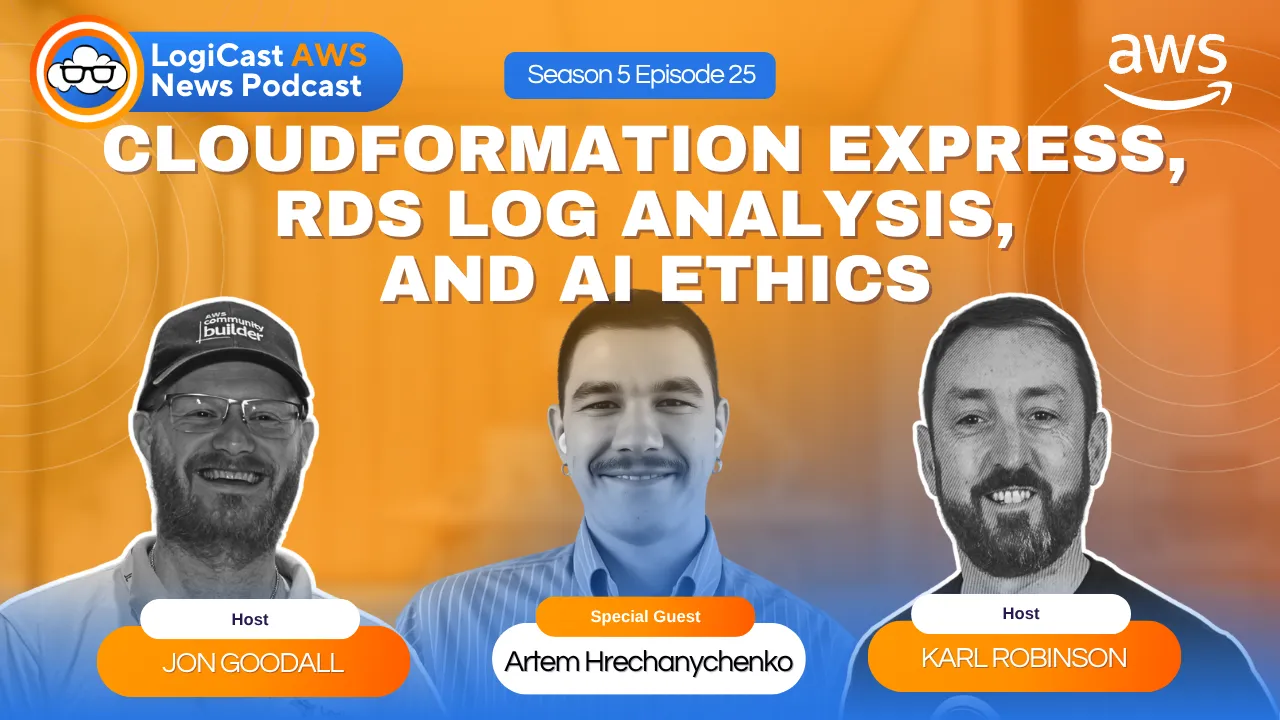
Welcome to season 5, episode 25 of the LogiCast AWS News podcast, brought to you by Logicata. I’m Karl Robinson, CEO and co-founder of Logicata, and I’m joined today by Jon Goodall, our principal cloud engineer. We are also delighted to have Artem Hrechanychenko, a fellow AWS community builder, with us today. Artem, how are you doing?
Artem: Hi, guys. I’m doing well. It’s Monday, so I’m trying to get some energy to get through all my work. I’m really glad to be here.
Karl: Artem is based in Spain and is deeply involved in the AWS community. He works with customers to deal with observability, infrastructure as code, Kubernetes, and platform engineering. He’s also passionate about creating educational materials and has been working to craft his skills through various certifications. Artem, what do you do for a living when you’re not contributing to the AWS community?
Artem: I’m trying to survive in this crazy world, keeping my humanity intact while working with complex abstractions. I work with customers to manage observability, infrastructure as code, and a lot of Kubernetes and platform engineering. I also enjoy creating educational materials and engaging in conversations about the job market for my Ukrainian community. I used to play football for about 15 years but realized that clouds are more my passion.
Karl: Speaking of passion, we’ve got some exciting AWS news to discuss today. Our first article is about how you can accelerate your infrastructure deployments by up to 4 times with CloudFormation Express Mode. Jon, as a Terraform shop, what caught your eye about CloudFormation Express Mode?
Jon: I’ve had quite a bit of experience with CloudFormation, especially when I was working for Cloudreach. The issue with CloudFormation, regardless of whether you use AI or not, is that it takes a long time because it performs stabilization checks. For example, creating an SQS with a DLQ in standard mode takes 64 seconds, but in express mode, it completes in 10 seconds by skipping the stabilization check. This is particularly useful for cleaning up resources like deleting a Lambda function with a network attachment, which can take half an hour but now does it in 10 seconds.
Artem: I like Terraform but have also worked with CloudFormation and CDK. CloudFormation Express Mode sounds promising, especially for quickly deploying and cleaning up resources without waiting for validation. It could be a painkiller for those who find CDK cumbersome.
Karl: Our second article is about Amazon RDS log analysis using Qiro and MCP. Jon, have you tried doing any Amazon RDS log analysis with Qiro and MCP?
Jon: I haven’t because I’ve found the built-in chat integration in CloudWatch log management pretty good. However, I see a use for Qiro and MCP if you need to extract data for custom graphing or analysis. It might be more useful for organizations that rely solely on AWS and want to protect data flow.
Artem: I think Qiro and MCP can be useful for developers who don’t have access to production environments but need to analyze incidents. It can make their lives easier by providing a familiar interface without needing to switch to other tools.
Karl: Our third article discusses safely releasing frontier models to customers, focusing on ethics and policies around model governance. Artem, what are your thoughts on this scenario?
Artem: It seems like the US government is creating a precedent for controlling new models. There might be prompt censorship, where certain prompts are not answered. This is already happening with guard rails, and I think it sets a concerning trend for commercial use of models.
Jon: The situation with Anthropic’s Fable 5 model being pulled and then redeployed shows government overreaction and backtracking. However, it highlights the importance of safety measures and prompt guardrails to prevent misuse.
Karl: Moving on, we’ve seen AWS raise GPU instance prices by 20% starting July 1st. Jon, what are your thoughts on this?
Jon: This is the third time in two decades that AWS has raised prices without disguising it as a price-to-performance increase. It signals that things are starting to get more expensive, especially in the AI infrastructure backend. This price increase makes sense as the cost of acquiring and running these resources is rising.
Artem: This is how capitalism works. Initially, you sell something cheaply to gain traction, and then prices rise as businesses start to cut costs. We should expect more price increases and tokenomics to come into play.
Karl: Our final article discusses AWS claiming to have added more data center capacity than any other company in 2025, including 1.2 gigawatts in Q4. Jon, what do you think about this?
Jon: It’s interesting that AWS has added so much capacity globally, but it raises questions about where the power is coming from and its ecological impact. The rush to add capacity might strain the grid, and we need to consider the environmental consequences.
Artem: From an economic perspective, this capacity addition shows Amazon’s ability to keep up with market needs and return on investments. However, the ecological impact, such as water consumption, is concerning. We might see a shift back to quantum computing as the AI hype cycle dies down.
Karl: Before we wrap up, let’s thank Artem for joining us and sharing his insights. We also appreciate Jon’s crispiness and my sun tan from the weekend. If you enjoyed this episode, please share it with your friends, give us a like, and follow us on YouTube. We’ll be back next week with another guest and another episode.
This is an AI generated piece of content, based on the Logicast Podcast season 5, episode 25.